Stage 01 · 3 sheets
Plumbing Permits, Bids and Inspections
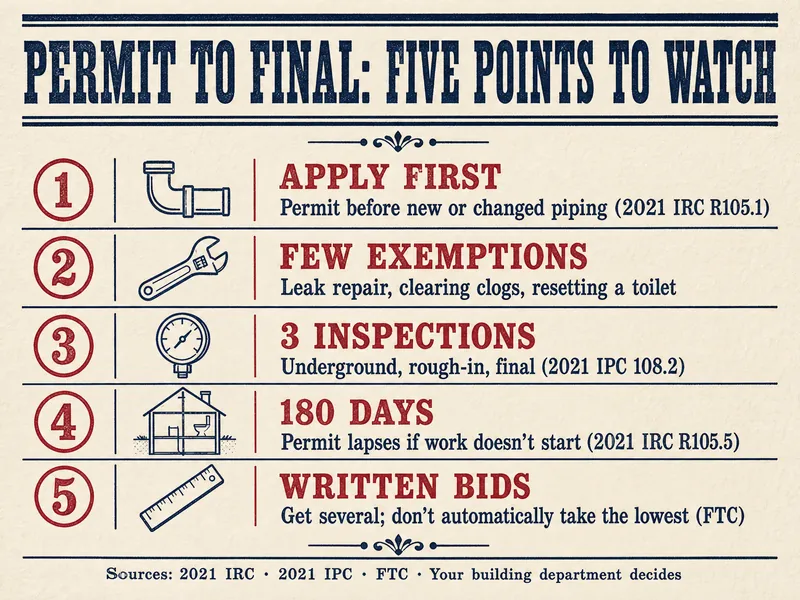
Plumbing permits come first: the model codes require one before new or changed piping goes in, then written bids set the scope and three inspections check the work.
Set by the Trench to Trim desk from code, agency and maker documents · how pages are made · Updated
Proof marks
- The 2021 IRC requires a permit before anyone installs, alters, repairs or replaces a regulated plumbing system.
- The model codes exempt very little: stopping leaks, clearing clogs, and pulling and resetting a toilet with nothing replaced.
- A permit lapses after 180 days if work does not start, under the 2021 IRC, 2021 IPC and 2024 UPC.
- The 2021 IPC names 3 required inspections: underground, rough-in and final.
- The FTC says to get several written estimates and not automatically pick the lowest bidder.
- Rio Rancho, New Mexico may charge a reinspection fee when called-for corrections are not made.
When does plumbing work need a permit?
Plumbing work needs a permit whenever pipe, valves or fixtures are added, moved or replaced, unless your city's own list exempts it. The 2021 IRC and IPC both start from that rule, and the 2024 UPC exempts the same short list of repairs. Cities then widen or narrow it: Bend, Oregon lets you swap a faucet, sink or toilet that is not concealed in the wall, while Buffalo, New York requires a permit to replace most individual fixtures.
The plumbing permit page lists what usually triggers one, what is exempt, and how long a permit stays good.
Which inspections happen on a plumbing job?
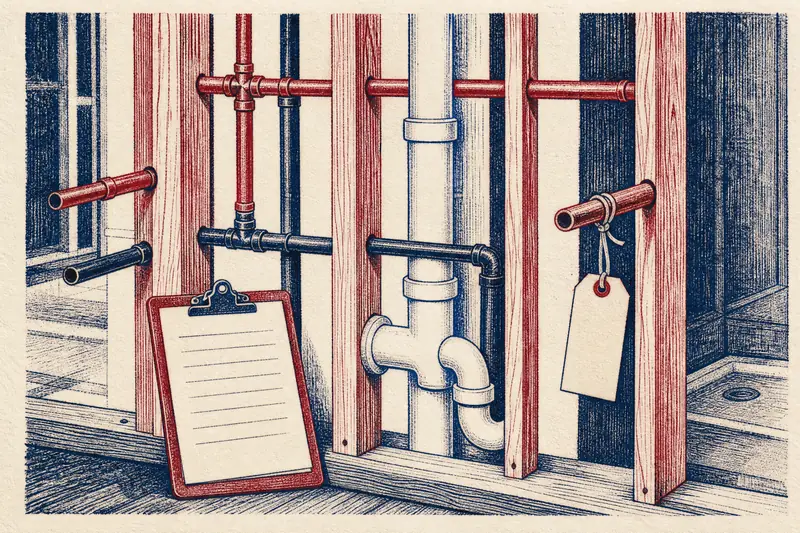
Three inspections happen under the model codes: underground before backfill, rough-in before wall coverings, and final once fixtures are connected. That is the 2021 IPC's list, and the UPC uses the same three. Many cities add a fourth: Rio Rancho inspects a top-out stage once piping above the floor reaches the roof and walls.
Each inspection is a gate. Work does not continue past it until the inspector approves, so the schedule for underground plumbing and every later trade hangs on these visits.
| Source | Inspections named | Note |
|---|---|---|
| 2021 IPC 108.2 | Underground, rough-in, final | Permit holder schedules each one |
| 2024 UPC 105.2 | Underground, rough-in, final | Covered work must be uncovered on notice |
| Rio Rancho, NM | Rough-in, top-out, final | Top-out before any piping is concealed |
| West University Place, TX | In-ground, top-out, final | 2021 IRC with local amendments |
How do you compare plumbing bids?
Compare plumbing bids line by line on scope before you look at the total. Line up fixture count, pipe material, who pulls the permit, which tests are included, allowances and exclusions. The FTC says a written estimate should describe the work, materials, completion date and price, and its hiring brochure adds the license number and a payment schedule to the contract.
The bid comparison page has the full checklist and the red flags.
Permit and bid numbers
- 3Required plumbing inspections in the model code2021 IPC 108.2
- 180 daysPermit lapses if work doesn't start2021 IRC R105.5
- 1 working dayTime to file the permit after an emergency repair2021 IRC R105.2.1
- 3 business daysRight to cancel a contract signed at homeFTC
Why do plumbing jobs fail inspection?
Plumbing jobs fail inspection most often because the test isn't on the system, protection or access is missing, or the work doesn't match the approved plans. Common flags include no water or air test holding when the inspector arrives, missing nail plates, drains without enough slope, buried cleanouts and relief valve pipes that end in the wrong place.
A failed inspection is a list of corrections, not a verdict on the whole job. The inspection failures page explains the usual items and the re-check.
Who pulls the permit?
The licensed plumber usually pulls the plumbing permit, and the permit holder is responsible for scheduling inspections under the 2021 IPC. Some places let a homeowner pull one for their own home: Kentucky allows it if the owner does all the work personally, and Bend allows only the homeowner or a licensed plumber to do the work. The FTC warns that scammers ask you to get the required permits, so be wary when a contractor wants the permit in your name.
Calls that belong to the plumber or inspector
- Gas piping and gas appliance connections need a licensed plumber or gas fitter, a permit and an inspection.
- If you smell gas, get everyone out; from outside and away from the house, call 911 or the gas utility.
- Whether work needs a permit is your building department's call, not the contractor's.
- Only the inspector can approve a test or let walls be covered.
- Your building department and a licensed plumber have the final word.
Pages in permits and bids
 Permits and bids: Do you need a plumbing permit?
 Permits and bids: How to compare plumbing bids
 Permits and bids: Why plumbing inspections fail
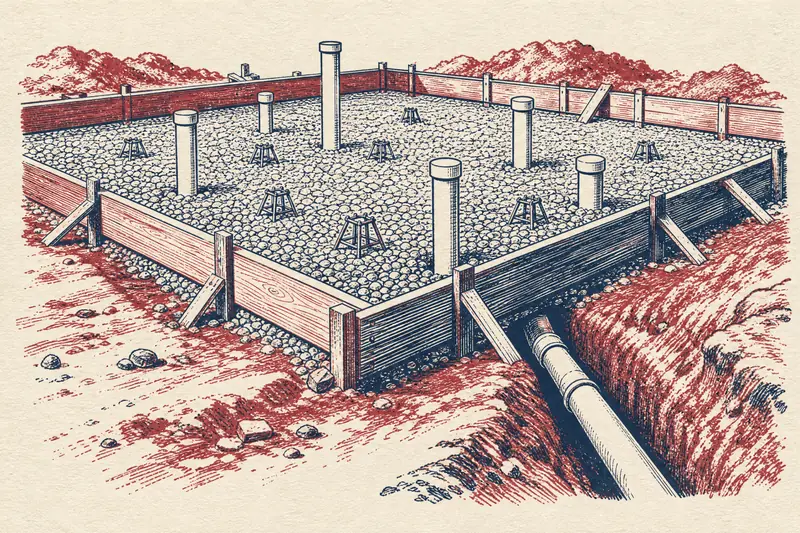 Stage folder: Next stage: underground plumbing
Pressman's note
Built from the 2021 IRC and IPC (ICC) and the 2024 UPC (IAPMO) permit and inspection chapters, permit pages from Bend, Oregon, Buffalo, New York and Kentucky's plumbing division, inspection pages from Rio Rancho, New Mexico and West University Place, Texas, and two FTC consumer publications, all read in October 2026. Permit fees, inspection fees and contractor names are left out; your building department sets those rules.
Questions from the job site
Is a permit needed to replace a water heater?
In many cities, yes. Bend, Oregon lists water heater replacement, expansion tank included, as permit work, and gas units bring their own gas and venting checks.
Can work start while the permit is under review?
Not under the model codes, which require the permit before work begins. The 2021 IRC's exception is an emergency repair, with the application filed the next working business day.
Who keeps the inspection card?
The permit holder keeps it posted or available on site until the final is approved; Rio Rancho requires its notice sheet to stay on the job site until then.
Do bids include the permit fee?
Sometimes. Ask each bidder whether permit and inspection fees are in the price or billed separately, and get the answer in writing.
Does a remodel need the same inspections as a new house?
Usually rough-in and final at least. A remodel with no underground work may skip that inspection; a slab drain move brings it back.
What happens if a permit expires mid-job?
Under the 2021 IRC, a permit goes void when 180 days pass between inspections; the building official may grant written extensions. Ask before the date passes.