How to Compare Plumbing Bids
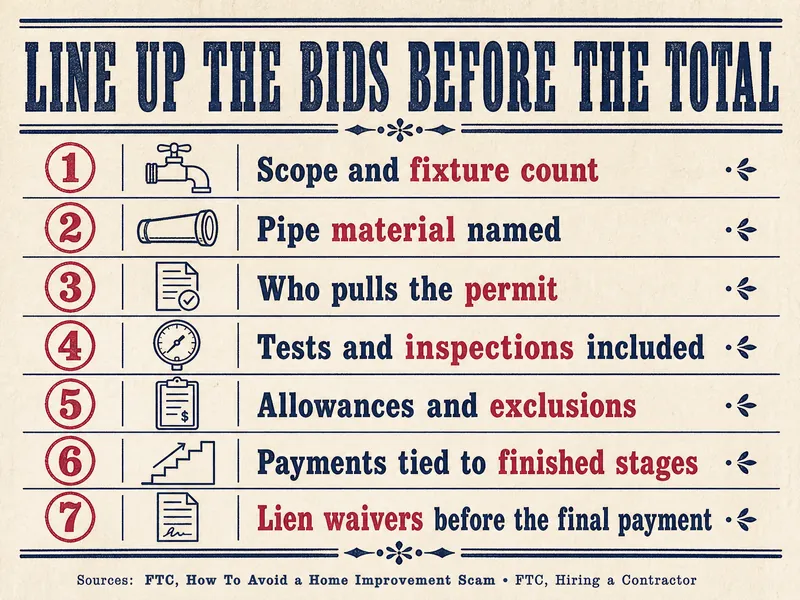
To compare plumbing bids fairly, line up scope, fixture count, pipe material, permit, tests, allowances and exclusions on one sheet first, and only then compare the totals.
Set by the Trench to Trim desk from code, agency and maker documents · how pages are made · Updated
About the business links: Trench to Trim is run by the same people who own Plumbing Supply and More, SoftPro Water Systems and Quality Water Treatment, and it has a working tie to Central Plumbing & HVAC. No business pays for a mention. Who owns this site
Proof marks
- The FTC says a written estimate should include a description of the work, materials, completion date and price, and warns against automatically choosing the lowest bidder.
- The FTC's Hiring a Contractor brochure lists the license number, start and completion dates, payment schedule and the contractor's duty to get permits as contract items.
- The FTC says some states limit the down payment a contractor may ask for, and to never make the final payment until the work is done.
- A contract signed at your home carries a 3-business-day right to cancel, per the FTC.
- Lien releases or waivers from the contractor and every subcontractor and supplier protect you from a mechanic's lien, the FTC brochure says.
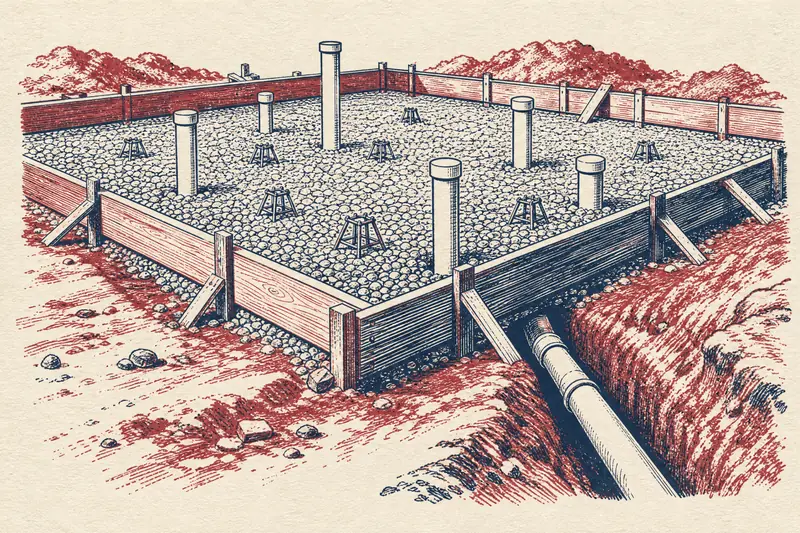
- The 2021 IPC names 3 inspections (underground, rough-in, final), so a complete bid says which ones its price covers.
How do you compare plumbing bids fairly?
Compare plumbing bids fairly by putting every bid's scope on the same sheet, line by line, before you read a single total. Two bids that differ a lot are often pricing different jobs: one counts the laundry box and hose bibbs, the other leaves them out, or one includes the permit and tests while the other bills them later. The FTC's advice is to ask for an explanation of the gap before deciding.
Give every bidder the same package to price: the plans, a fixture list with model numbers, and a note on who supplies fixtures. Then make a column per bidder and fill in the rows below. Blank cells are questions for the bidder, not reasons to pick someone.
| Line | What to look for | Question to ask |
|---|---|---|
| Scope and fixture count | Every fixture, appliance hookup and hose bibb listed by room | Is anything on the plans left out? |
| Pipe material | Named supply pipe (PEX, copper type) and drain pipe | Which material, and does the city accept it? |
| Permit | Who pulls it, and whether fees are in the price | Is the permit in your company's name? |
| Tests and inspections | Underground, rough-in, top-out where used, final | Are re-inspections included? |
| Allowances | A named amount set aside for items not yet chosen | What happens if the choice costs more? |
| Exclusions | Drywall, patching, gas, electrical, concrete cutting | Who does the excluded work? |
| Payment schedule | Draws tied to finished stages | What triggers each payment? |
What should a plumbing bid include?
A plumbing bid should include a written description of the work, the materials, a completion date and the price, which is the FTC's minimum for any home improvement estimate. For plumbing, that description means the fixture count, the pipe materials and sizes where they matter, the water heater by type and size, and the stages the price covers.
The contract that follows should go further. The FTC brochure lists the contractor's name, address and license number if required, an estimated start and completion date, the payment schedule for the contractor, subcontractors and suppliers, and the contractor's obligation to get all necessary permits. Pipe choice is its own question: the PEX vs copper page explains why bids name different materials, and with copper your local code and the bid decide between types K, L and M.
Check the license yourself. California's licensing board notes that a license number on its own isn't proof and tells consumers to check status online; Texas offers a public license search showing status and expiration. Your state has its own lookup.
What are allowances and exclusions?
An allowance is a placeholder amount in the bid for something not chosen yet, and an exclusion is work the bid leaves out on purpose. Allowances usually cover fixtures and trim: a faucet, a shower valve trim kit, a toilet. If the one you pick costs more, the difference comes back to you, so a bid with low allowances can look cheaper than it is.
Exclusions are where bids quietly differ. Common ones on remodel plumbing are opening and patching drywall, cutting and patching a slab, gas piping, electrical work for a water heater or disposal, and hauling away old fixtures. Make sure each excluded item is in someone's bid. Choosing fixtures before rough-in shrinks the allowances; the rough-in heights page shows why the plumber needs the spec sheets early.
Who pays for permits and inspections?
The homeowner pays for permits one way or another, so the bid should say whether permit and inspection fees are inside the price or billed on top. The person who pulls the permit should be the licensed plumber; the FTC lists "Scammers ask you to get any required building permits" among its warning signs. The plumbing permit page covers when one is needed.
Ask about failed inspections too. Rio Rancho, New Mexico may charge a reinspection fee when work isn't complete or corrections called for are not made. A bid should say who pays if the plumber's work fails, which the inspection failures page explains.
Bid and contract numbers
- 3 business daysCancellation window when you sign at homeFTC
- 3Plumbing inspections a full bid should account for2021 IPC 108.2
- 4Things every written estimate should include: work, materials, completion date, priceFTC
How is a plumbing bid usually paid?
A plumbing bid is usually paid in draws tied to finished stages, with a limited deposit up front and the final payment after the work passes. The FTC says not to pay the full amount up front, notes that some states cap the down payment, and suggests making payments contingent on completing defined amounts of work.
Plumbing's natural payment points are the inspections: underground approved, rough-in approved, final approved. Before the last check, ask for lien releases or waivers from the plumber and every subcontractor and supplier, as the FTC brochure advises; unpaid suppliers may be able to file a mechanic's lien against your home under state law. Never make the final payment until the work is done and you're satisfied, the FTC says.
Which red flags should you look for?
The biggest red flags are a lump-sum price with no scope, a request that you pull the permit, pressure to pay in full up front, and no license number. The FTC also tells consumers to consider only contractors who hold a license and carry insurance and to confirm the license with the state or county.
Watch for bids that skip tests or name no pipe material, which leaves room to swap later. Be wary of any bid that offers to skip the permit to save time. If a company doesn't spell out its work, compare it with how a company like Central Plumbing & HVAC lays out its plumbing services (Central Plumbing & HVAC, a company with a working tie to Trench to Trim); it serves only Bucks and Montgomery counties in Pennsylvania, so treat it as one example of the detail to look for on any company bidding your job.
Leave these to licensed pros and the inspector
- Gas piping, gas water heaters and tankless gas sizing belong in a licensed plumber's or gas fitter's bid, never in a homeowner's "excluded, owner to do" line.
- If you smell gas, get everyone outside right away, touch no switches and make no calls indoors; once well away, call 911 or the gas utility.
- Water heater venting, relief valve piping, backflow devices and electrical hookups need the right licensed trade.
- The inspector, not the bidder, decides whether the work passes.
- Your building department and a licensed plumber have the final word.
Pressman's note
This page is built from the FTC's "How To Avoid a Home Improvement Scam" web page and its "Hiring a Contractor" brochure, the 2021 IPC inspection section, Rio Rancho, New Mexico's inspection information, and license lookup pages from California's CSLB and the Texas plumbing board, read in October 2026. It gives no prices, price ranges or typical markups, and it names no contractor as a recommendation.
Questions from the job site
How many plumbing bids should you get?
The FTC says to get written estimates from several firms. With three, you can usually see which lines differ without the comparison sheet getting unreadable.
Should the lowest plumbing bid win?
Not automatically, the FTC says. Ask the low bidder to explain the gap; it is often a missing fixture, an excluded wall patch or a cheaper allowance.
Can you ask a plumber to itemize a lump-sum bid?
Yes. Ask for the fixture count, materials, permit and test lines, allowances and exclusions in writing. A bidder who won't is telling you something.
What is a change order?
A written, signed change to the contract's scope or price after work starts. Ask how each bidder handles them, and sign before the extra work is done.
Are re-inspection fees part of a plumbing bid?
They should be addressed. Some cities charge one when corrections aren't made; the bid should say the plumber covers re-checks caused by their own work.
Does a new-construction bid differ from a remodel bid?
Yes. A new build is priced by fixture count and stage; a remodel adds demolition, unknowns behind walls and patching, so its exclusions list matters more.
More on permits and bids

Back to the Trench to Trim job board