The Shower Pan Liner Flood Test
A shower pan liner test plugs the drain and floods the shower floor with at least 2 inches of water, then leaves it for 15 minutes under the model codes or 24 hours where local rules ask, before any tile goes on.
Set by the Trench to Trim desk from code, agency and maker documents · how pages are made · Updated
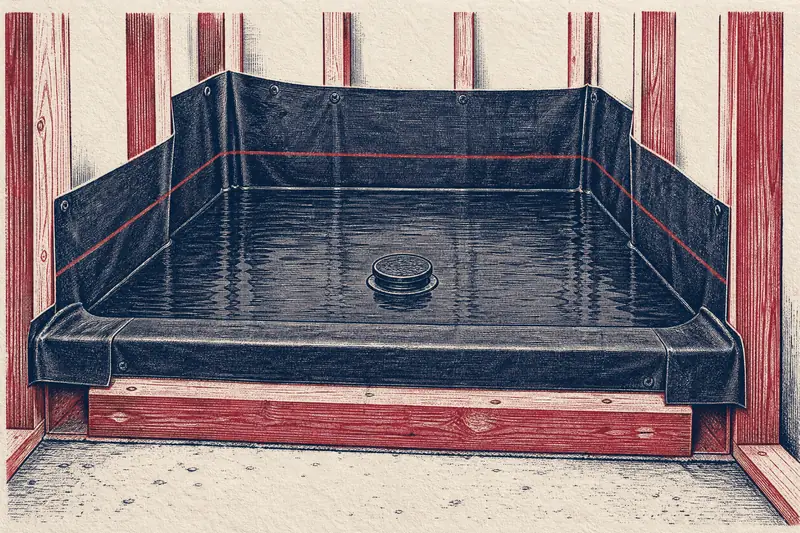
Proof marks
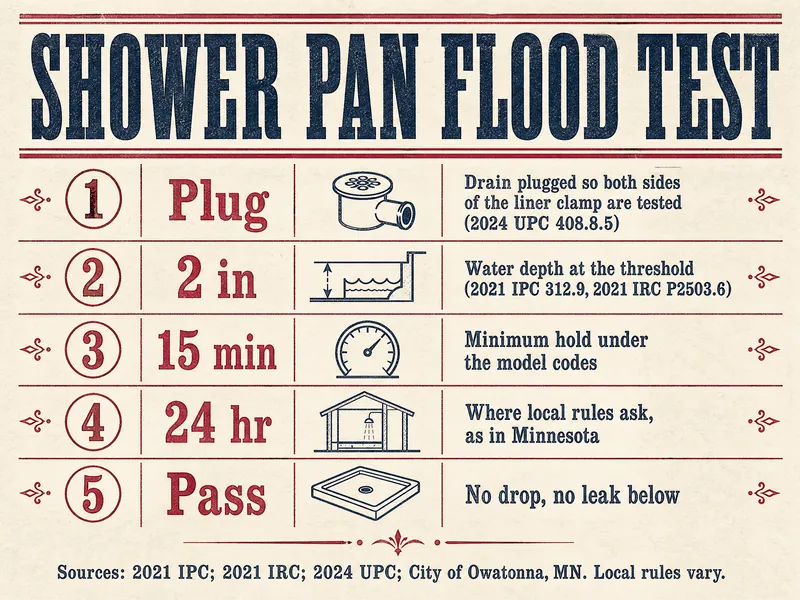
- The 2021 IPC (312.9) fills the pan to at least 2 inches at the threshold and holds it at least 15 minutes with no sign of leakage.
- The 2021 IRC (P2503.6) and the 2024 UPC (408.8.5) use the same 2-inch, 15-minute minimum.
- Minnesota's plumbing code, as applied by Owatonna, MN, requires at least 24 hours.
- Under the 2021 IPC (421.5.2), a built-in liner turns up at least 2 inches above the finished threshold and slopes 1/4 inch per foot to the drain.
- Schluter's shower system handbook says to wait at least 24 hours after its membrane goes on before a water test.
- Bend, Oregon's permit list names installing or replacing a shower pan as permitted work.
What is a shower pan liner test?
A shower pan liner test is a flood test of the waterproof layer under a tiled shower floor: the drain is plugged, the pan is filled with water, and the level is watched to prove nothing leaks before the mortar bed and tile cover it. Under the 2021 IPC (312.9), the floor and receptor are filled with potable water to at least 2 inches measured at the threshold, with a temporary dam if the curb is lower than that. It happens at top-out, before the walls and floor are finished.
The liner itself has rules the test proves out. The 2021 IPC (421.5.2) wants a built-in liner to turn up at least 2 inches above the finished threshold and slope 1/4 inch per foot to the drain. The 2024 UPC (408.8) lines the subfloor and walls to at least 3 inches above the finished dam and pitches the lining 1/4 inch per foot to the weep holes.
The test also checks the joint people worry about most: where the liner clamps to the drain. The 2024 UPC (408.8.5) says the test plug is placed so both sides of the subpan are tested at that clamp.
How long does a shower pan test last?
A shower pan test lasts at least 15 minutes under the model codes (2021 IPC and IRC, 2024 UPC) and 24 hours in many places that set their own rule. The 2021 IPC, 2021 IRC and 2024 UPC all ask for at least 2 inches of water held for at least 15 minutes with no evidence of leakage. Minnesota's code, as quoted on Owatonna's self-certification form, says "it is required to test for a minimum duration of 24 hours."
Many inspectors ask for 24 hours too, but that is a local rule, not the 2021 IPC, 2021 IRC or 2024 UPC. Ask the building department or the permit card which applies before the pan goes in, because it changes the schedule: a 24-hour test holds up the tile setter for a day. Owatonna, for one, offers an in-person check followed by a second visit 24 or more hours later.
Who performs and inspects it?
The installer fills the pan and the inspector or the building department decides whether to see it in person. In Owatonna, Minnesota, the city accepts a self-certification form signed by the installer and the owner's representative, uploaded before the final inspection, or it will inspect in person and return 24 or more hours later.
Who the "installer" is depends on the trade split. On many jobs a plumber sets the drain and a tile setter builds the pan, so the bid should say who builds, tests and repairs it; comparing plumbing bids covers how to spot that gap. If the pan is covered before it is tested and approved, the 2024 UPC (105.2.1) lets the inspector order it uncovered.
Your part is to be there or get proof. Photograph the water line marked on the liner at the start and the end with the time visible, and note the date on your copy of the permit paperwork.
How do bonded waterproofing membranes change the test?
Bonded membranes still get a flood test, but the timing comes from the membrane maker, because thin-set or liquid coats have to cure first. The 2021 IRC (P2709.2) accepts sheet-applied, load-bearing bonded membranes meeting ANSI A118.10 as a shower lining. Schluter says its KERDI and DITRA membranes meet that standard.
Schluter's handbook says "a water test is strongly recommended before setting tile" and to wait 24 hours minimum after the membrane goes on, so the thin-set at seams and connections sets. LATICRETE's HYDRO BAN XP instructions allow flood testing typically 2 hours after final cure at 70°F and 50% humidity, and 24 hours after final cure between 35°F and 69°F. Your inspector may still ask for the local duration, so the two clocks add up.
What if the water level drops?
If the water level drops, the pan fails until the cause is found and the test is repeated. The model codes pass a test only when "there shall not be evidence of leakage," so a drop, a damp ceiling below or water at the drain clamp all mean a repair. A tiny drop over 24 hours can be evaporation, which is why a clear mark and photos at both ends help everyone judge it.
The repair belongs to whoever built the pan, under the contract. A liner pinched by a nail, a cut corner or a loose drain clamp is fixed, and the pan is filled again for a full new test. Do not let tile start on a pan that "mostly" passed; finished tile has to come out to reach the liner later, and the inspection failures page shows how a correction is logged.
What does a curbless pan change?
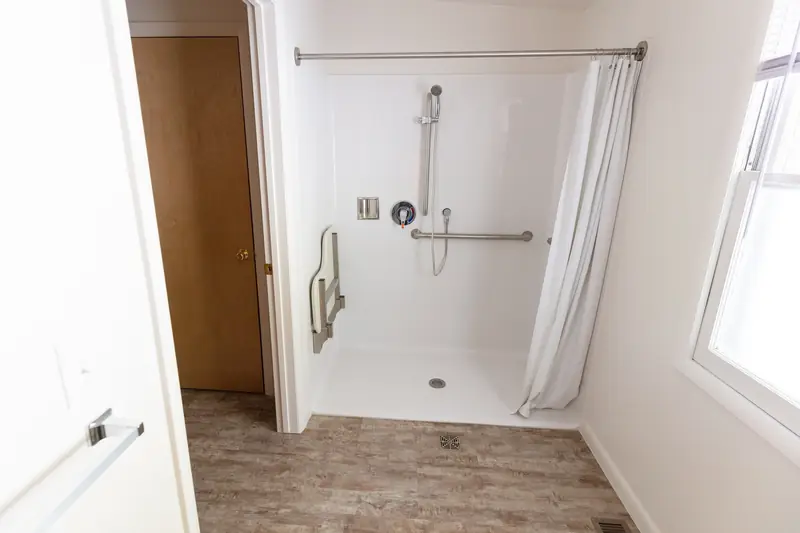
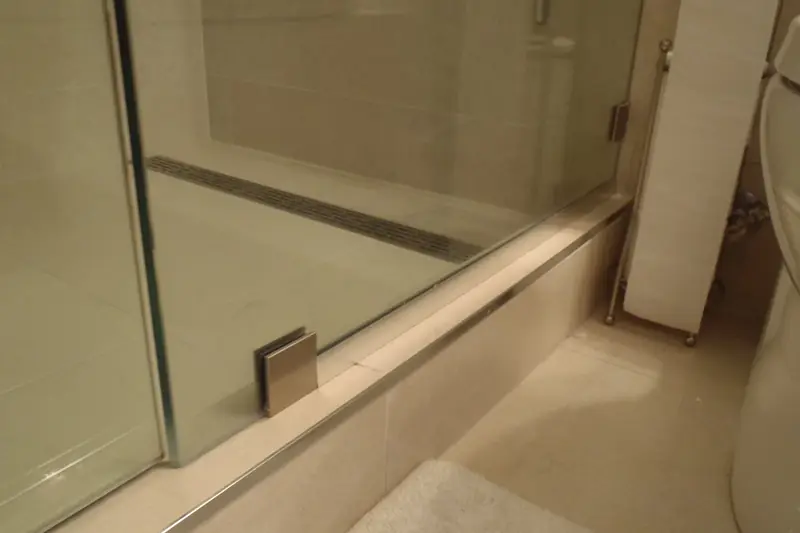
A curbless pan has no curb to hold the test water, so it needs a temporary dam at the entry for the flood test. Schluter's handbook says "for curbless showers a temporary dam must be provided at the threshold to perform the water test," and the 2021 IPC (312.9) calls for a dam whenever the threshold is under 2 inches. The test then proves the whole wet area, not just the shower footprint.
Curbless showers also widen what has to be waterproof. The 2024 UPC (408.6) treats the floor of the same room as a wet location when a shower has no threshold, and Schluter says waterproofing belongs in all areas exposed to water, ideally the entire floor. See curbless shower plumbing for drains and slope, and plumbing top-out for the other tests at this stage.
| Rule set | Water depth | Minimum time | Notes |
|---|---|---|---|
| 2021 IPC 312.9 | 2 in at the threshold | 15 minutes | Temporary dam if the threshold is under 2 in |
| 2021 IRC P2503.6 | 2 in at the threshold | 15 minutes | Same wording for one- and two-family homes |
| 2024 UPC 408.8.5 | 2 in | 15 minutes | Plug placed to test both sides of the drain clamp |
| Minnesota code (Owatonna form) | To the rough threshold | 24 hours | Self-certification accepted by Owatonna |
| HYDRO BAN XP (maker) | Per local code | Test 2 to 24 hours after final cure | Cure time depends on temperature |
Flood test numbers
- 2 inminimum water depth at the threshold2021 IPC 312.9
- 15 minminimum hold under the model codes2021 IRC P2503.6
- 24 hrminimum hold under Minnesota's codeCity of Owatonna
- 1/4 in/ftliner slope to the drain2021 IPC 421.5.2
Inspector's and installer's call
- Test length and whether it is witnessed are set by your building department; 24 hours is a local or state rule, not the 2021 IPC, IRC or 2024 UPC.
- Building the pan, setting the drain clamp and repairing a failed liner are the installer's work under the permit; the retest is a full new test.
- Floors that must be recessed for a curbless shower can affect structure; that is a design professional's call.
- Your building department and a licensed plumber have the final word.
Pressman's note
Sources, read in October 2026: the 2021 IPC sections 312.9 and 421.5.2 and the 2021 IRC sections P2503.6 and P2709.2 (ICC), the 2024 UPC sections 105.2.1, 408.6, 408.8 and 408.8.5 (IAPMO), the City of Owatonna's shower liner self-certification form, the City of Bend's permit list, Schluter's shower system handbook and LATICRETE's HYDRO BAN XP instructions. We left out cure times for other membranes, which vary by product.
Questions from the job site
Does a prefabricated shower base need a flood test?
The liner test in the model codes is written for built-in pans with a liner or membrane. A factory base is set to its maker's instructions instead. Ask your inspector, because some departments still want to see it.
Can the flood test happen after the tile is set?
Not usefully. The point is to find a leak while the liner is still reachable, and finished tile has to come out to fix one. Schluter strongly recommends testing before tile for that reason.
Who pays if the pan fails?
That is a contract question, not a code one. Your bid or contract should name who builds the pan, runs the test and repairs a failure; check that wording before work starts. Ask for the retest date in writing.
How full is "2 inches at the threshold"?
The depth is measured where the shower meets the bathroom floor, which is the lowest edge. With a 1/4-inch-per-foot slope, water near the drain is deeper. Some local codes, like Minnesota's, fill to the rough threshold instead.
Should I be there for the flood test?
It helps. Look at the water line mark at the start, the end, and the ceiling or subfloor below. Photos with the time visible settle questions about evaporation later.
Does a tub need a flood test?
The liner test applies to shower floors built in place. A bathtub is a factory fixture and its drain is tested with the rest of the drain system. A tub-to-shower conversion with a built-in pan gets the liner test.
More on top-out