PEX vs Copper for a Remodel or New Build
PEX vs copper comes down to joints, fittings and handling: both are made for drinking-water lines, and your local code, the pipe maker's instructions and the plumber's bid decide which goes in.
Set by the Trench to Trim desk from code, agency and maker documents · how pages are made · Updated
About the business links: Trench to Trim is run by the same people who own Plumbing Supply and More, SoftPro Water Systems and Quality Water Treatment, and it has a working tie to Central Plumbing & HVAC. No business pays for a mention. Who owns this site
Proof marks
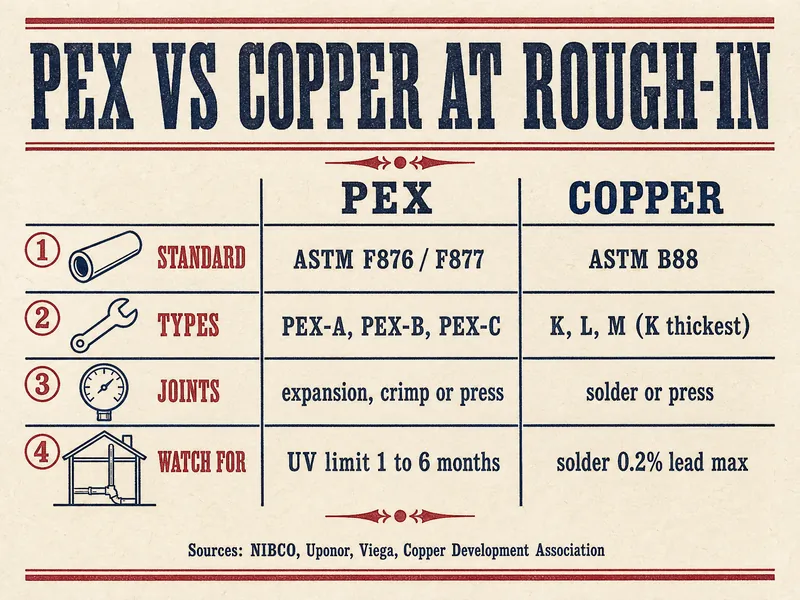
- PEX tubing is made to ASTM F876 and PEX hot- and cold-water systems to ASTM F877, rated for 100 psi water at up to 180°F, per the NIBCO catalog.
- Viega's manual says the letters in PEX-a, PEX-b and PEX-c name the crosslinking method and are not a quality rating.
- PEX sunlight limits run from one month to six months depending on the pipe; check the code printed on it and the maker's sheet.
- Copper Types K, L and M are all listed for water service; K has the thickest wall and M the thinnest, per the Copper Development Association.
- Solder with more than 0.2% lead has been banned for drinking-water lines since the 1986 Safe Drinking Water Act amendment.
- Viega, for one, calls for 18 inches or more of metal pipe at a gas-fired water heater before its PEX begins.
How do PEX and copper compare for water lines?
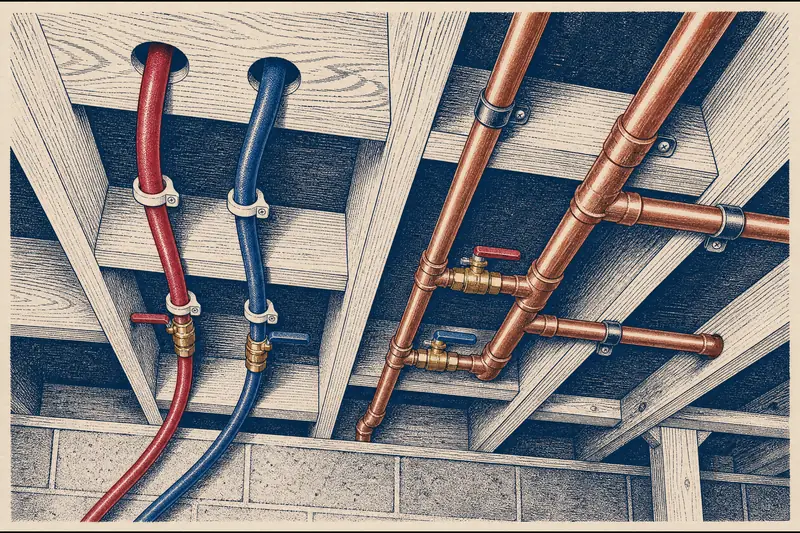
PEX and copper both carry hot and cold drinking water, and the real differences are in how they are joined, how they are run and what can damage them. PEX is a flexible plastic tube that bends around framing and comes in coils, so fewer fittings sit inside the wall. Copper is rigid tube cut to length and joined at every turn by soldering or with press-connect fittings.
Each has its own weak spots. PEX must be kept out of sunlight and away from high heat, while soldered copper needs a torch flame that press-connect fittings avoid. Neither choice changes the inspections: the supply lines are pressure tested and inspected at rough-in either way, as the plumbing rough-in page explains.
What is the difference between PEX-A and PEX-B?
PEX-A and PEX-B differ in how the polyethylene is crosslinked, and that changes which fittings and repairs suit them. NIBCO names three methods: peroxide (Engel), silane (moisture cure) and electron beam, known as PEX-a, PEX-b and PEX-c. ASTM F876 requires 65 to 89 percent crosslinking whichever method is used.
The practical differences show up on the job. Uponor uses the shape memory of its PEX-a for cold-expansion joints, and its installer instructions let the plumber restore a kinked section of PEX-a with a heat gun rather than cutting it out. Viega's PEX-b instructions say to cut out a kink and install a repair coupling instead. Trench to Trim picks no winner: makers on both sides claim advantages, and the fitting system your plumber uses matters more than the letter.
Which fittings go with each?
Each PEX fitting system is tied to its own standard and tool. ASTM F1960 cold-expansion fittings (Uponor ProPEX) rely on PEX-a's shape memory; ASTM F1807 metal insert fittings and ASTM F2159 plastic insert fittings use a copper crimp ring; and Viega PureFlow Press fittings use a factory-fitted stainless sleeve with viewing holes. Ask the bid to name the pipe brand and the fitting system, because mixing brands is limited by each maker's instructions.
Copper joints are soldered, brazed or made with press-connect fittings. The CDA handbook notes that press-connect joints need no heat or open flame, unlike soldering. Whatever the method, joining pipe is the plumber's work; this page explains what to look for, not how to do it.
How do they handle freezing and sunlight?
PEX resists freeze damage better than rigid pipe, but no maker says it should be allowed to freeze. Viega writes that flexibility makes its tubing resistant to freeze damage and that it should not be installed where it will freeze; Uponor says its PEX-a handles freeze-thaw cycles better than other piping but that the missing insulation or heat should be fixed. Plan insulation and routing so neither material sits in an unheated space.
Sunlight is the bigger PEX risk during construction. Uponor rates its white AquaPEX for one month of UV exposure and its red and blue for six months, and Viega's 5306-rated tubing for six. Both makers want PEX stored covered and out of the sun, and Uponor also keeps it out of direct view of fluorescent and LED lights within 5 feet unless shielded. Copper has no comparable sunlight limit in the sources read for this page.
Can PEX and copper be mixed in one house?
Yes, PEX and copper are often joined in the same system with fittings made for that transition. Viega sells adapters that join its PEX to copper tube and to copper fittings, and it says sweat (soldered) connections should be made before the PEX is attached so the tube is not damaged. Uponor's installation manual says not to solder or braze within 18 inches of its PEX on the same water line.
Water heaters are the most common meeting point. Viega says its PEX should not connect directly to a gas-fired water heater and calls for at least 18 inches of metal pipe, with the tubing kept more than 6 inches from the vent; Uponor allows direct connection to electric and power-vented gas heaters where local code allows. Uponor also says no PEX between a tub/shower valve and the tub spout.
What stays with the plumber and inspector
- The choice of pipe material and copper type is set by your adopted code, the plans and the plumber's bid.
- Water heater connections, gas piping and venting are licensed work; follow the pipe maker's distance rules near any heater.
- Soldering, brazing, crimping, expanding and pressing are done by the plumber; do not join or repair pipe yourself in a permitted job.
- Air testing PEX is allowed only where the code and the maker's instructions permit it.
- Your building department and a licensed plumber have the final word.
What do the codes and makers require?
Both materials have to meet listed standards and pass the same pressure test. The 2021 IRC tests water supply piping with water at working pressure or more for 15 minutes, and accepts a compressed-gas test of PEX only where the maker's instructions specifically authorize it; the 2024 UPC has a similar exception. For drinking water, look for the NSF-pw mark on PEX: it means NSF/ANSI 14 performance plus NSF/ANSI 61 health effects, while NSF-rfh tubing is made for radiant heat and carries no health-effects review.
Copper's rule is in the solder. The CDA notes that solder with more than 0.2% lead has been banned for potable water since 1986, and that "plumbing and mechanical codes govern what types may be used" among K, L and M. Older homes may still have lead solder on old copper, which the lead pipes page covers. Where pipe passes near a stud face, both plastic and copper need steel plates; that check happens at top-out.
If you want to see what the parts are called before reading a bid, the supply house's PEX tube (Plumbing Supply and More, run by the owners of Trench to Trim) and copper tube (Plumbing Supply and More, run by the owners of Trench to Trim) pages list sizes and types the way a bid line will. Installation stays with the licensed plumber.
PEX and copper numbers
- 65-89%crosslinking range ASTM F876 requires for PEXNIBCO catalog
- 100 psiPEX system rating at 180°F under ASTM F877NIBCO catalog
- 6 monthsmaximum UV exposure for PEX printed 5306Viega PureFlow manual
- 0.049 inwall of 1/2-inch Type K copper (L 0.040, M 0.028)Copper Development Association
- 0.2%most lead allowed in solder for drinking-water linesCopper Development Association
| Pipe | How it is made or graded | Joints | Damage or kink repair | Note |
|---|---|---|---|---|
| Uponor AquaPEX (PEX-a) | Peroxide (Engel) crosslinking | ASTM F1960 cold expansion | Installer may heat-restore per Uponor | White pipe 1 month UV; red and blue 6 months |
| Viega PureFlow (PEX-b) | Silane crosslinking | F1807 crimp or PureFlow Press | Cut out and install a repair coupling | 5306 rating: 6 months UV |
| Copper Type L | Middle wall thickness, blue print | Solder, braze or press-connect | Plumber cuts and rejoins | Listed for water service and distribution |
| Copper Type M | Thinnest wall, red print | Solder, braze or press-connect | Plumber cuts and rejoins | CDA's minimum for water distribution; local code decides |
Pressman's note
Sources: NIBCO's flexible piping catalog, Uponor's FAQ and seventh-edition installation manual, Viega's PureFlow installation manual and engineering specifications, the Copper Development Association's tube handbook and the 2021 IRC and 2024 UPC test sections, read in October 2026. Maker claims about one PEX type beating another were left out, as were installation steps and any prices.
Questions from the job site
Is PEX safe for drinking water?
PEX sold for drinking water carries a potable mark such as NSF-pw, which NIBCO describes as NSF/ANSI 14 performance plus NSF/ANSI 61 health effects. Tubing marked only NSF-rfh is for radiant floor heating and has no health-effects evaluation, so check the print on the pipe.
Which copper type is used for house water lines?
Types K, L and M are all made for water lines, with K the thickest wall and M the thinnest. Your local code and your plumber's bid decide which one is used; the CDA's own minimum for water distribution is Type M.
Can PEX connect straight to a water heater?
It depends on the heater and the maker. Viega asks for an 18-inch-plus run of metal pipe off a gas-fired heater, while Uponor allows direct connection to electric and power-vented gas heaters where local code allows. Water heater hookups are licensed work, and the water heater placement page covers the rest.
Does PEX make hot water take longer to arrive?
Wait time depends on pipe size and length more than material. A DOE Building America example found 50 feet of 1/2-inch PEX holds 0.46 gallon, about 28 seconds at 1 gpm, while 3/8-inch tubing held 0.25 gallon and took about 15 seconds.
What is a PEX manifold?
A manifold feeds each fixture with its own line from one central fitting, often called home-run piping. The DOE Building America guidance says a properly installed home-run system delivers hot water quickly compared with trunk-and-branch piping, which sends water a longer way.
Can PEX be used between a shower valve and a tub spout?
Not with Uponor PEX: its manual says not to install the pipe between the tub/shower valve and the tub spout. Ask the plumber what the valve maker specifies for that short run.
How long can PEX sit in a sunny garage or yard?
Only as long as its UV rating allows, which runs from one month to six months depending on the product. Uponor says not to store its PEX outdoors at all, and Viega wants tubing kept covered and shielded from direct and indirect sunlight.
More on rough-in materials