Why Plumbing Inspections Fail
A plumbing inspection usually fails for fixable reasons: no test holding on the pipe, missing nail plates, drains without enough slope, buried cleanouts, or a water heater detail out of place.
Set by the Trench to Trim desk from code, agency and maker documents · how pages are made · Updated
Proof marks
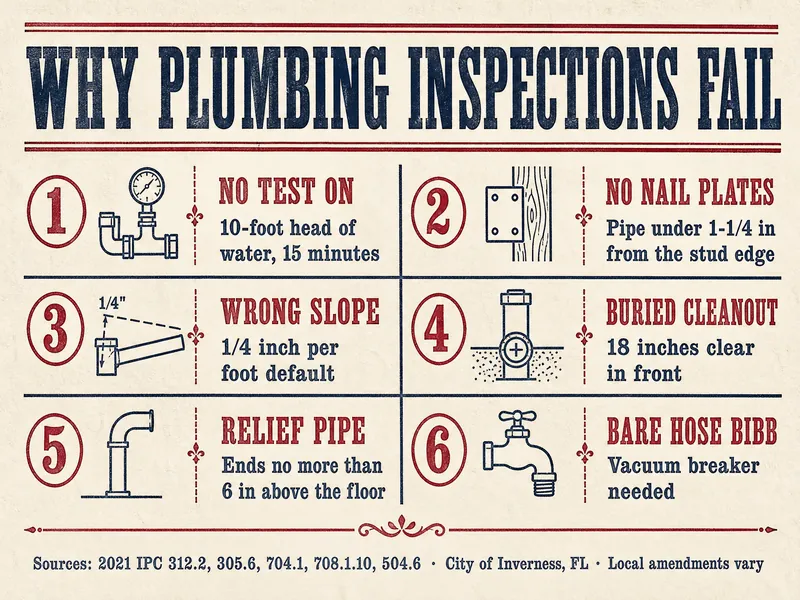
- The 2021 IPC water test on drain and vent piping keeps at least a 10-foot column of water in place for 15 minutes; plastic pipe may not be air tested.
- Pipe bored through framing less than 1-1/4 inches from the edge needs a 16-gauge (0.0575-inch) steel plate under the 2021 IPC and IRC; the 2024 UPC uses 1 inch and 18 gauge.
- The 2021 IPC wants cleanouts on pipe up to 6 inches to have 18 inches clear in front of the opening.
- Under the 2021 IPC, a water heater's relief pipe must stop within 6 inches of the floor or the receptor it drains into.
- Inverness, Florida's final checklist requires vacuum breakers on hose bibbs and approval of all earlier inspections.
- Rio Rancho, New Mexico may charge a reinspection fee when called-for corrections are not made.
Why do plumbing inspections fail?
Plumbing inspections fail when the inspector can't confirm the work meets the adopted code: the test isn't holding, something required is missing, or the work isn't visible. Most failures are small and specific, and each item on the list can be fixed and re-checked. The plumbing inspection checks what is in front of the inspector that day, so a job that isn't ready reads as a failure too.
Readiness counts. Rio Rancho lists reinspection triggers that have nothing to do with pipe quality: work not complete, the building not accessible, the job-site notice sheet not posted, and approved plans not on site. The 2021 IPC adds that work "shall not be done beyond the point" of each inspection, so a failed rough-in stops drywall, insulation and everything after it.
Which rough-in failures are most common?
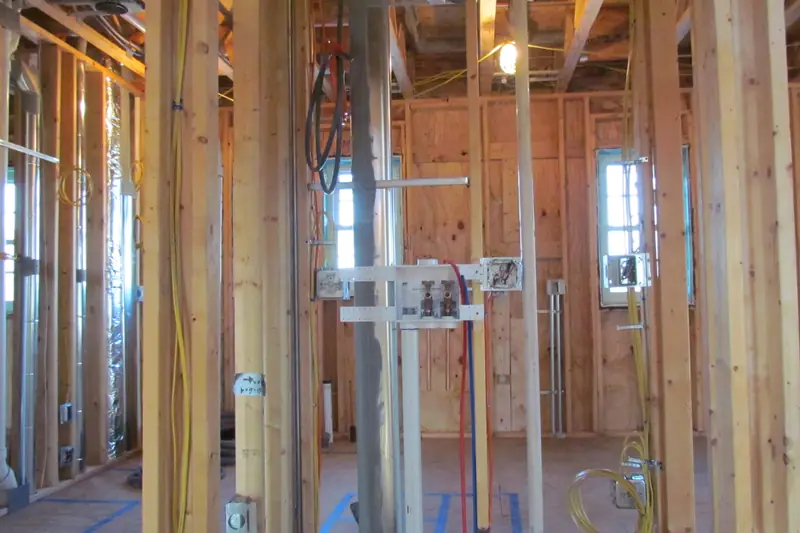
The most common rough-in failures are a test that isn't on or isn't holding, missing nail plates, drain lines with too little slope, and venting or cleanouts that don't match the code your city adopted. Each one is checked before walls close, which is why the rough-in plumbing page and the top-out stage spend so much time on them.
The test. Under the 2021 IPC and IRC, drain and vent piping is water tested to a 10-foot head for 15 minutes, or air tested at 5 psi for 15 minutes on non-plastic pipe; the IRC also allows a vacuum test on plastic. Some cities want more: West University Place, Texas asks for a 20-minute test and says that if the test stack has no water, "a leak will be assumed."
Nail plates. The 2021 IPC and IRC call for a 16-gauge steel plate where pipe passes less than 1-1/4 inches from the face of a stud or joist, extending 2 inches past sole and top plates. 2024 UPC areas use 1 inch and 18 gauge. The nail plates and blocking page shows where they go.
Slope. The 2021 IPC and IRC let drains 3 inches across or bigger run at 1/8 inch per foot; the 2024 UPC allows that only on larger building drains with the inspector's prior approval. That makes 1/4 inch per foot the safe default anywhere.
Visibility. West University Place asks that all fittings be exposed and all material labels visible at the in-ground inspection. Pipe buried or wrapped before the visit can't be checked.
| Item | What the inspector looks for | Rule cited |
|---|---|---|
| Drain and vent test | 10-foot head of water held 15 minutes, no leaks | 2021 IPC 312.2 |
| Nail plates | 16-gauge plate where pipe is under 1-1/4 inches from the edge | 2021 IPC 305.6 |
| Drain slope | At least 1/4 inch per foot on small drains (2-1/2 inches or less) | Table 704.1, 2021 IPC |
| Cleanout access | 18 inches clear in front; not concealed | 2021 IPC 708.1.10; 2021 IRC P3005.2.10 |
| Relief valve pipe | Full size, untrapped, ending no more than 6 inches above the floor | 2021 IPC 504.6 |
| Hose bibbs | Vacuum breaker backflow prevention | Inverness, FL final checklist |
| Thermal expansion | A means of controlling it on the water heater | Inverness, FL; 2021 IPC 607.3 |
Which final inspection items get flagged?
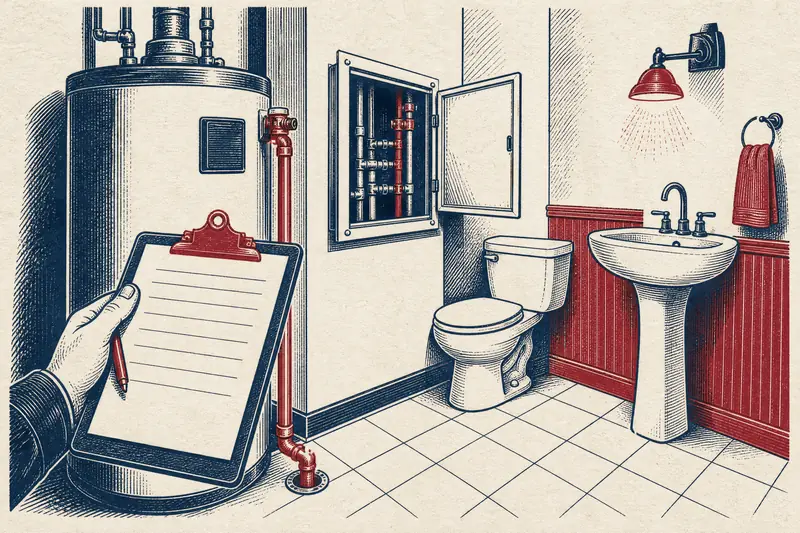
Final inspections get flagged most for water heater details, missing backflow protection, missing shutoffs and leaks at fixtures. Inverness's final checklist is a good example of the list an inspector carries: a full-open shutoff at the water heater, a relief pan where the heater is in a habitable space, a relief valve that discharges to a safe place, thermal expansion control, a main shutoff where the water enters, vacuum breakers on hose bibbs, a shutoff at each fixture except residential tubs and showers, every fixture trapped, and vent flashings in place.
The water heater draws the most attention. Under the 2021 IPC, the relief pipe can't have a threaded end, a valve or a tee, and its outlet stops within 6 inches of the floor. Where the UPC applies, the heater's pan is not an allowed end point. The final plumbing inspection page covers the whole sign-off, including access panels and the paperwork that closes the permit.
What does a correction notice mean?
A correction notice means the inspector didn't approve that stage and has listed what must change before a re-check. It is not a stop on the whole project, but it does hold the next step: Rio Rancho's rules say a portion that doesn't comply "shall be corrected" and may not be covered until the inspector authorizes it.
Read the notice with the plumber the day it is posted. Each line should name an item and, often, the code section; if a line is unclear, the plumber can ask the inspector. The 2024 UPC also lets the inspector order work uncovered if it was concealed before approval, which is the costly kind of correction.
Numbers inspectors check
- 10 ft / 15 minWater test head and hold time for drain and vent piping2021 IPC 312.2
- 1-1/4 inDistance from the framing edge that triggers a steel nail plate2021 IPC 305.6
- 18 inClear space in front of a cleanout on 6-inch and smaller pipe2021 IPC 708.1.10
- 6 inHighest point above the floor where a relief valve pipe may end2021 IPC 504.6
- 20 minIn-ground water test time in West University Place, TexasCity of West University Place
How do you prepare for the inspector?
Prepare by making sure the test is on, the work is visible, the paperwork is on site and someone can let the inspector in. That covers most of Rio Rancho's reinspection triggers before they happen. Inverness's list starts with "Check plans-permit", and it wants the maker's instructions for a garage water heater on hand at inspection.
A homeowner's part is access and records, not the test itself. Clear the room, unlock the house, keep pets away, and photograph each open wall with a tape measure in the frame before the visit. Ask the plumber to confirm the test gauge or standpipe is filled and holding, and that the permit card is posted. The underground inspection page covers the slab version of this checklist.
What does a re-inspection involve?
A re-inspection checks the corrected items, and the job moves on once they pass. Ask for one only when every listed item is done; Rio Rancho may charge a reinspection fee and won't do further inspections until any assessed fee is paid. If earlier stages were never approved, the final can't pass either: Inverness requires all previous inspections to be approved first.
Decide who pays before work starts. A good contract says the plumber covers re-checks caused by their own work; the bid comparison page shows where that line goes, and the permits and bids overview ties the stages together.
What only the plumber or inspector should do
- Setting up, filling and reading a drain, vent or supply test is the plumber's job; the inspector decides whether it passed.
- Water heater relief valve piping, venting, expansion control and gas connections are licensed work; a dripping relief valve is a call for the plumber, never something to block.
- If you smell gas during any inspection or test, get everyone out first, flip nothing and make no calls inside, and call 911 or the gas utility from outside.
- Backflow assemblies are tested by a certified tester.
- Your building department and a licensed plumber have the final word.
Pressman's note
This page uses the test, protection, slope, cleanout and water heater sections of the 2021 IPC and IRC (ICC) and the 2024 UPC (IAPMO), the plumbing checklist of West University Place, Texas (Rev. 01112022), the plumbing final inspection checklist of Inverness, Florida, and the inspection and reinspection rules posted by Rio Rancho, New Mexico, read in October 2026. It has no failure-rate statistics, because no public source with them was found, and no reinspection fee amounts.
Questions from the job site
Can you be present for a plumbing inspection?
Usually, if you can let the inspector in. Ask the permit holder for the scheduled day; being there lets you hear any correction explained.
Does a failed plumbing inspection mean the plumber did bad work?
Not necessarily. A test that lost pressure overnight, a missing label or a locked door can fail a visit. Repeated failures on the same item are a different story.
Can the walls be closed after a failed rough-in?
No. Corrected work stays uncovered until the inspector approves it, and covered work can be ordered opened.
Why did the inspector ask for a longer test than the code book says?
Cities can amend the model codes. West University Place, Texas uses a 20-minute in-ground test, and Minnesota's code asks for 24 hours on a shower pan.
What if the inspector and the plumber disagree?
The plumber can ask the inspector which code section applies; if that doesn't settle it, ask the building department how it reviews disagreements. The adopted code and the building official decide.
Do re-inspections push back the schedule?
Yes, by however long the city takes to return, and later trades wait. Booking the re-check right after corrections are finished keeps the delay short.
More on permits and bids