Water Heater Sizing and Placement
Water heater sizing and placement get decided at rough-in: the first-hour rating or flow rate sets the size, and the location sets pipe runs, venting, the drain pan and the space a plumber needs to service it.
Set by the Trench to Trim desk from code, agency and maker documents · how pages are made · Updated
About the business links: Trench to Trim is run by the same people who own Plumbing Supply and More, SoftPro Water Systems and Quality Water Treatment, and it has a working tie to Central Plumbing & HVAC. No business pays for a mention. Who owns this site
Proof marks
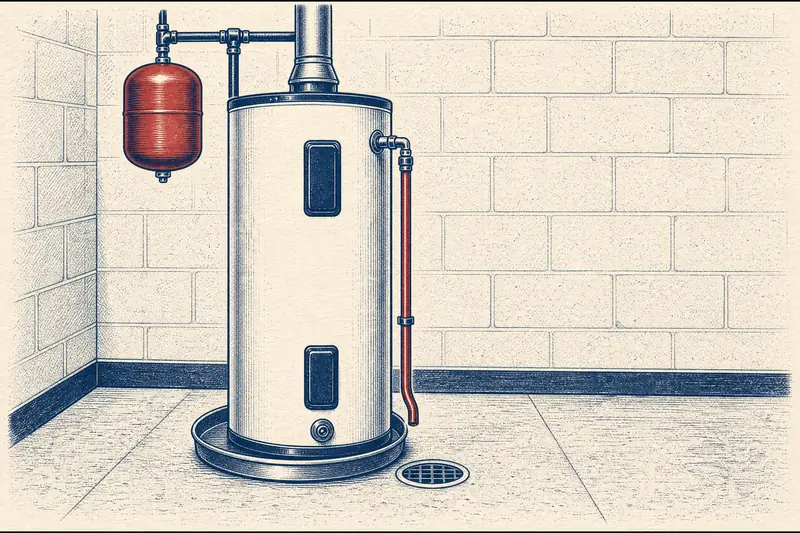
- A storage heater is sized by its First Hour Rating on the EnergyGuide label, not its tank gallons, per University of Georgia Extension.
- Tankless units are sized by peak flow in gallons per minute and the temperature rise needed, per a DOE Building America report.
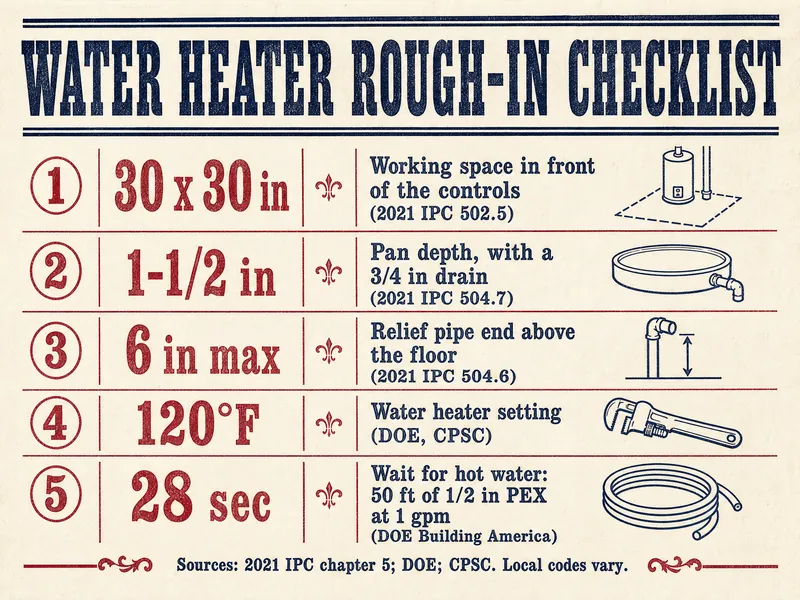
- In that DOE report, 50 feet of 1/2-inch PEX holds 0.46 gallon, about 28 seconds of waiting at 1 gpm.
- The 2021 IPC (502.5) wants a level working space at least 30 by 30 inches in front of the controls.
- A tank heater where a leak would cause damage sits in a pan at least 1-1/2 inches deep with a 3/4-inch drain under the 2021 IPC (504.7).
- DOE and the CPSC both point to a 120°F water heater setting.
How do you size a water heater for a new build?
You size a water heater for a new build by the household's busiest hour. For a tank heater, that means its First Hour Rating (FHR), which University of Georgia Extension says "should match the amount of water that your household needs when it uses the most hot water each day." The FHR is printed on the EnergyGuide label, and the same extension sheet notes it is not the same as tank size; most units deliver more than their tank capacity in the first hour.
That 2006 extension sheet gives a rough starting point: about 45 to 55 gallons of FHR for 2 people, 65 to 75 for 4, and 100 or more for 7 or more. Treat it as a rule of thumb. For a heat pump water heater, ENERGY STAR suggests sizing up when switching from a gas tank.
Tankless units are sized differently, by flow and temperature rise. The DOE Building America measure report says the maximum demand at any one time and the temperature rise needed "must be used to size the unit," using the maker's charts. Colder incoming water means a bigger rise and a bigger unit.
Where should the water heater go?
The water heater should go as close as practical to the fixtures that use the most hot water, with room around it for service. DOE's Building America report says a heater "should be located centrally or as close as possible to the points of use," with short runs to each.
Service space is a code item. The 2021 IPC (502.5) wants a level working space at least 30 by 30 inches in front of the control side, and its section 502.3 sets an attic passageway at least 30 inches high, 22 inches wide and no more than 20 feet long.
Garages and heat pump units have their own limits. The 2024 UPC (507.13) wants burners and ignition parts of appliances in a residential garage at least 18 inches above the floor unless the appliance is listed flammable vapor ignition resistant (FVIR). ENERGY STAR says heat pump units belong in spaces kept between 40° and 90°F year-round, with about 450 to 1,000 cubic feet of air depending on the model. In UPC areas, the heater is also strapped against earthquakes in its upper and lower thirds (2024 UPC 507.2).
What does tankless change at rough-in?
Tankless changes the gas line, the venting and the water treatment question, all of which have to be settled before walls close. Rinnai's technical bulletin TB-111 says its tankless units "typically require a 3/4" gas line," with 1/2 inch possible only in some short, high-pressure cases, and its manual says gas pipe is sized for the whole house load from NFPA 54. Rinnai also states that "a licensed professional must install the gas supply."
Water quality matters more with tankless. The DOE Building America report says "hard water will damage the tankless water heater," so the cold supply should be tested before choosing equipment. A water softener is one option where a test shows hard water; the SoftPro ECO softener (SoftPro Water Systems, run by the owners of Trench to Trim) is one example, and roughing in a water softener loop now lets one be added later.
What safety parts does a water heater need?
A water heater needs a relief valve with a proper discharge pipe, a cold-water shutoff, and in many homes a drain pan and an expansion tank. Under the 2021 IPC (504.6), the relief valve pipe runs full size by gravity, without valves or tees, and stops within 6 inches of the floor or waste receptor, with no threads on its end. Its allowed end point depends on your code, since the 2024 UPC prohibits discharge into the pan.
The pan rule in the 2021 IPC (504.7) applies where a leak would cause damage: at least 1-1/2 inches deep, drained by a pipe at least 3/4 inch, and never plastic under a gas heater. The 2021 IPC (503.1) wants a shutoff valve on the cold line serving only the heater. Expansion control is needed under the 2021 IPC (607.3) when one-way parts such as check valves, pressure reducers or backflow assemblies close off a storage heater's supply, and under the UPC with any normally closed device; backflow preventers and expansion tanks explains the trigger.
Temperature is a safety part too. DOE recommends 120°F, and the CPSC urges lowering water heaters to 120°F and notes that most tap-water scald injuries and deaths involve older adults and children under five. The CDC notes 130–140°F controls Legionella but raises burn risk; where a heater runs hotter, a mixing valve and each shower's own anti-scald valve manage that, and a household's healthcare provider can advise where someone is at risk.
Why does the pipe run length matter?
Pipe run length matters because every foot of pipe holds water that has to run cold before hot arrives. DOE's Building America report works an example: 50 feet of 1/2-inch PEX holds 0.46 gallon and takes about 28 seconds at 1 gpm, while the same run in 3/8-inch holds 0.25 gallon and takes about 15 seconds.
The same report says a home-run system, with a manifold and a separate line to each fixture, delivers hot water faster than trunk-and-branch piping. Ask the plumber to sketch the hot runs on the rough-in plan and to show the longest one. Pipe material has limits near a heater as well: Viega, for one, wants 18 inches or more of metal pipe before its PEX meets a gas-fired heater; see PEX vs copper.
If you want to see how tank models, pans and their drain sizes are listed before you read a bid, Plumbing Supply and More shows water heaters (Plumbing Supply and More, run by the owners of Trench to Trim) and water heater pans (Plumbing Supply and More, run by the owners of Trench to Trim) with their specs. Choosing and installing them stays with the licensed plumber.
Which water heater work is licensed-only?
Nearly everything that touches gas, venting, the relief valve or the wiring is licensed work, and replacing a heater needs a permit in many cities. Bend, Oregon's permit list, for example, names replacing a water heater, expansion tank included. Rinnai's manual states that installation and service "must be performed by a licensed professional," and DOE advises consulting a certified technician before buying a tankless unit.
Your part is the size, location and fuel decisions, plus a walk-through to confirm the pan, relief pipe, shutoff and service space match the bid. One note on money: the IRS says the federal 25C credit is not allowed for property placed in service after December 31, 2025 (checked October 2026), so look for state or utility programs instead.
| Type | How it is sized | What rough-in must provide | Source |
|---|---|---|---|
| Gas or electric storage tank | First Hour Rating on the EnergyGuide label | Pan where leaks cause damage, relief pipe route, 30 x 30 in service space | UGA Extension; 2021 IPC 502.5, 504.7 |
| Gas tankless | Peak gpm and temperature rise from maker charts | Gas line sized to NFPA 54 (often 3/4 in for Rinnai), vent route, water test | DOE Building America; Rinnai TB-111 |
| Heat pump storage | First Hour Rating; 50, 65 or 80 gal tanks | Space kept 40–90°F with enough air around the unit | ENERGY STAR |
| Electric tankless | Peak gpm and temperature rise | Electrical supply sized to the maker's manual, wired by an electrician | DOE Building America |
Numbers to know
- 30 x 30 inlevel working space in front of a water heater's controls2021 IPC 502.5
- 1-1/2 inminimum pan depth where a tank leak would cause damage2021 IPC 504.7
- 28 swait for hot water through 50 ft of 1/2-in PEX at 1 gpmDOE Building America
- 120°Frecommended water heater settingCPSC
Licensed work and safety stops
- Gas piping, gas line sizing, venting, combustion air and the relief valve and its discharge pipe are a licensed plumber's or gas fitter's work; a relief valve is never capped, plugged or removed.
- Electrical supply for electric, heat pump or tankless heaters is an electrician's work.
- Smell gas? Get everyone out now. Don't flip switches, use phones, light anything or start a car inside; once outside and away, call 911 or the gas utility (or propane supplier).
- A carbon monoxide alarm sounding means get outside and call 911 from outside.
- Your building department and a licensed plumber have the final word.
Pressman's note
Sources: the 2021 IPC chapter 5 and section 607.3 (ICC), the 2024 UPC sections 507 and 608 (IAPMO), DOE's Building America tankless measure report (2012) and its 2022 Energy Saver booklet, University of Georgia Extension's water heater sheet (2006, used as a rule of thumb), ENERGY STAR heat pump water heater pages, CPSC publication 5098, CDC home water guidance, A.O. Smith and Rinnai manuals, Bend, Oregon's permit list and the IRS OBBB FAQ, each opened in October 2026. Prices, savings estimates and DOE's retired sizing web page were left out.
Questions from the job site
Can the water heater go in the attic?
Some codes allow it with a passageway and flooring: the 2021 IPC sets 30 inches high, 22 inches wide and 20 feet long at most. A.O. Smith advises against attic or upper-floor installs because of leak damage. If it must go up, a drained pan matters even more.
Does a tankless heater need a bigger gas line?
Often. Rinnai says its tankless units typically need a 3/4-inch gas line, and gas pipe is sized for the whole house load from NFPA 54. That sizing and the work itself belong to a licensed plumber or gas fitter.
Where should the relief valve pipe end?
It depends on the code your city adopted. The 2021 IPC allows the floor, the pan, a waste receptor or outdoors, stopping within 6 inches of the surface; the 2024 UPC rules out the pan. The plumber routes it and the inspector checks it.
Do I need an expansion tank with a new water heater?
The 2021 IPC requires expansion control when one-way parts close off a storage heater's supply; the UPC ties it to any normally closed device. Many cities treat one as part of every water heater job.
Does a heat pump water heater fit in a closet?
Sometimes. ENERGY STAR guidance ranges from about 450 to 1,000 cubic feet of air depending on the model, and a full louvered door can help in a closet. The maker's manual sets the number for your unit.
Who decides the final size?
You choose the target, and the plumber confirms it against the maker's FHR or flow charts and the pipe and gas sizing. Ask for the model number and its rating on the bid. The inspector checks the installation, not your comfort.
More on rough-in and trim-out
Back to the Trench to Trim job board