Backflow Preventers and Expansion Tanks
A backflow preventer stops water from hoses, sprinklers or equipment from flowing back into your drinking water; an expansion tank then gives heated water somewhere to go once that one-way path is closed.
Set by the Trench to Trim desk from code, agency and maker documents · how pages are made · Updated
About the business links: Trench to Trim is run by the same people who own Plumbing Supply and More, SoftPro Water Systems and Quality Water Treatment, and it has a working tie to Central Plumbing & HVAC. No business pays for a mention. Who owns this site
Proof marks
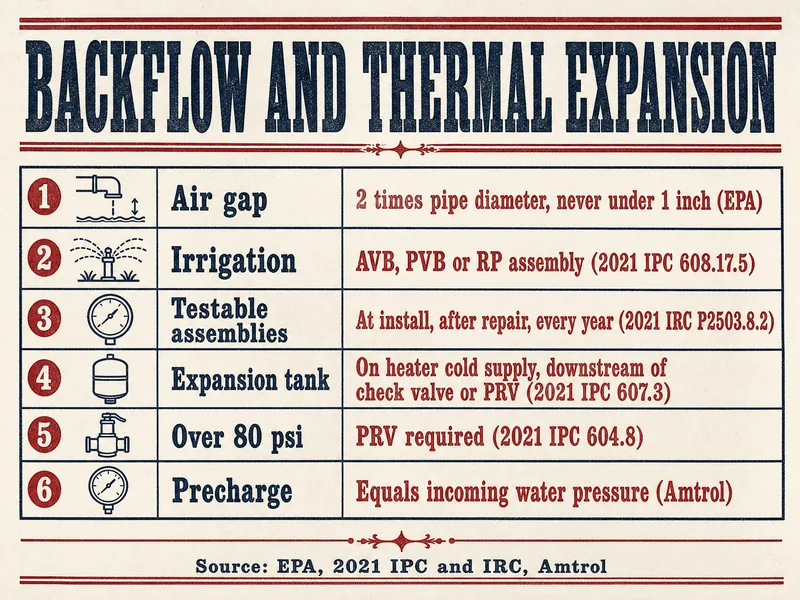
- EPA's Cross-Connection Control Manual defines an air gap as twice the supply pipe diameter, never less than 1 inch.
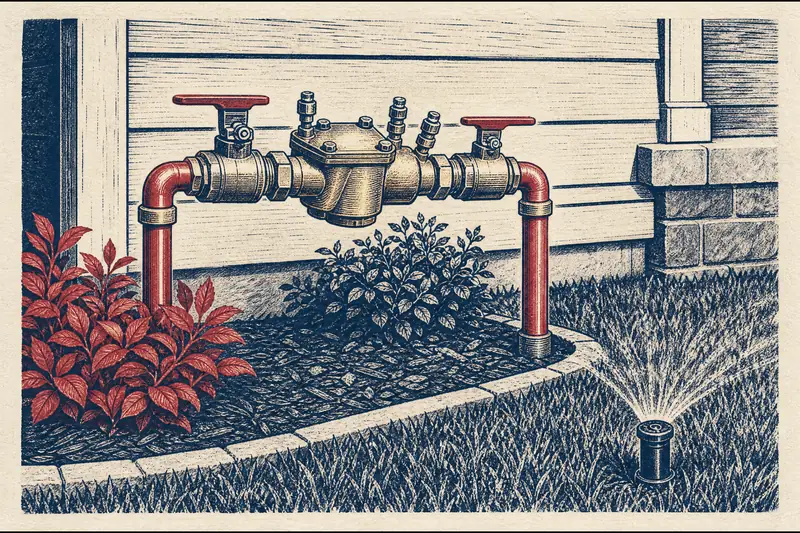
- The 2021 IPC section 608.17.5 requires a vacuum breaker or reduced-pressure assembly on lawn irrigation, and only a reduced-pressure assembly where chemicals are injected.
- The 2021 IRC (P2503.8.2) has testable backflow assemblies tested at installation, after repair or relocation, and every year.
- Under the 2024 UPC (603.4.2), the property owner has the assembly tested by a certified backflow tester.
- The 2021 IPC (607.3) requires thermal expansion control when a storage water heater's cold supply runs through a check valve, a PRV or a backflow device.
- Amtrol says an expansion tank's precharge is matched to the home's incoming water pressure before it is installed.
What does a backflow preventer do?
A backflow preventer keeps water that has left the drinking-water system from flowing back into it. EPA defines backflow as water or other substances flowing into potable supply pipes "from any source or sources other than its intended source," and backsiphonage as the kind caused by negative pressure in the supply pipes.
The risk sits at cross-connections, which EPA describes as any actual or potential link between the public supply and a source of contamination. A garden hose lying in a bucket of weed killer is one; a lawn sprinkler system with heads sitting in wet soil is another. The 2021 IPC 608.7 bans cross-connections unless an approved backflow assembly, device or method protects the supply.
The simplest protection is an air gap: open space between the end of a supply and whatever it fills. EPA puts that at twice the supply pipe diameter and never less than 1 inch. Where an air gap is not practical, a mechanical device or assembly does the job.
Where are backflow preventers required?
Homes most often need backflow protection at hose bibbs, irrigation systems, and sometimes at the water service itself, depending on the water utility. Inverness, Florida's final checklist says hose bibbs and hose connections require vacuum breaker backflow prevention and that the potable system must be protected from the irrigation system.
For lawn irrigation, the 2021 IPC accepts an atmospheric vacuum breaker (AVB), a pressure vacuum breaker (PVB) assembly or a reduced-pressure principle (RP) assembly, and only the RP type where chemicals are added. West University Place, Texas lists lawn irrigation and fire sprinkler systems among the places it wants a certified, tested device when code requires one. Your water utility and building department decide which device goes where.
| Device | Typical home use | Testable? | Who handles it |
|---|---|---|---|
| Air gap | Softener and dishwasher drains, fill points | No moving parts; inspected visually | Plumber installs; inspector checks |
| Hose bibb vacuum breaker | Outdoor faucets | Not on the IRC annual test list | Plumber fits at trim; inspector checks |
| Atmospheric vacuum breaker | Some irrigation systems | Not on the IRC annual test list | Plumber or irrigation contractor |
| Pressure vacuum breaker assembly | Irrigation | Yes, annually (2021 IRC) | Licensed installer; certified tester |
| Reduced-pressure principle assembly | Irrigation with chemicals, some services | Yes, annually (2021 IRC) | Licensed installer; certified tester |
| Double check assembly | Where the utility or code calls for it | Yes, annually (2021 IRC) | Licensed installer; certified tester |
Who tests backflow preventers?
Testable assemblies are tested by a certified backflow tester, not by the homeowner or a general contractor. The 2021 IRC requires reduced-pressure, double check, double check detector and pressure vacuum breaker assemblies to be tested at installation, right after any repair or relocation, and every year after that. The 2024 UPC puts the duty on the premises owner, using a certified tester.
Cities enforce this in their own way. Bend, Oregon requires homeowners with in-ground sprinklers to have a backflow assembly and to hire a state-certified tester every year. Durham, North Carolina gives owners 15 days to repair or replace an assembly that fails its annual test. Keep each test report with the house records.
Licensed and certified work only
- Backflow assemblies are installed by a licensed plumber or other licensed installer your city recognizes, and tested only by a certified backflow tester.
- Expansion tank sizing, precharge setting and connection on the water heater's supply are a licensed plumber's work, done from the tank maker's instructions.
- Pressure-reducing valves are installed and adjusted by the plumber; the water heater's relief valve and its discharge pipe must stay in place and unobstructed.
- Gas water heater connections and venting are licensed work. Smell gas? Get everyone out now, don't flip switches, use phones, light anything or start a car inside, and call 911 or the gas utility once outside.
- Your building department and a licensed plumber have the final word.
What is thermal expansion?
Thermal expansion is the pressure rise that happens when a water heater warms water in a system that cannot push it back toward the main. Water takes up more room as it heats; in an open system the extra volume eases back into the street main, but a check valve, backflow preventer or pressure-reducing valve on the service closes that path. The 2024 UPC 608.3 describes it as a "normally closed device that prevents dissipation of building pressure back into the water main."
That is why backflow and expansion tanks share a page: EPA's manual warns that a residential dual check at the meter creates a potential closed system that may need thermal expansion devices. If your project adds a check valve, a backflow preventer at the meter, or a pressure-reducing valve, ask how thermal expansion will be handled.
When is an expansion tank required?
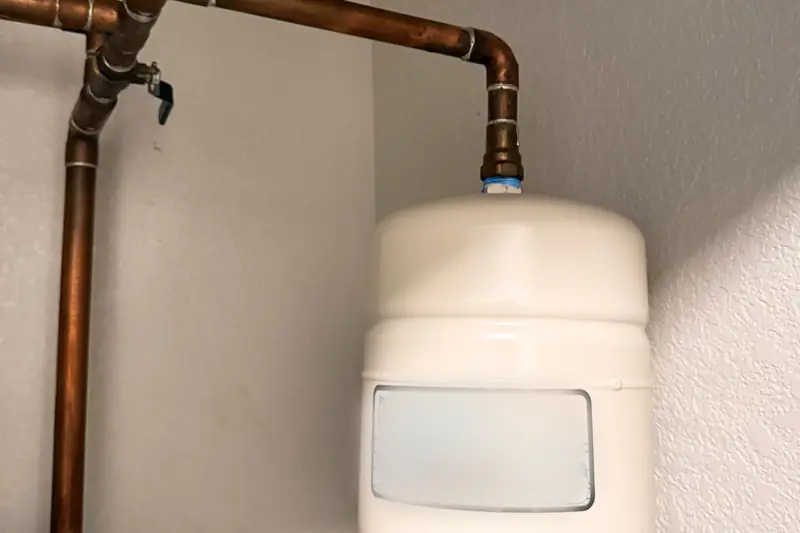
An expansion tank, or another approved device, is required when the water heater's supply passes through something that blocks backflow toward the main. Under the 2021 IPC (607.3), the trigger is a check valve, PRV or backflow device on the cold line to a storage heater, and the expansion device goes downstream of all of them. The 2024 UPC (608.3) covers any system with a normally closed device, whatever type of water heater it has.
Many cities treat a tank as part of every water heater job: Bend's permit list names "replace a water heater (including expansion tank)," and Inverness's final checklist asks for a means of controlling thermal expansion. Amtrol says its tanks go on the cold inlet to the heater, after any backflow or check valve, with the air precharge set to equal the incoming water pressure before installation. The heater side of this is covered on water heater placement and sizing.
How do pressure-reducing valves fit in?
A pressure-reducing valve (PRV) lowers high street pressure before it reaches the house piping, and it is one of the devices that closes the system. The 2021 IPC 604.8 requires an ASSE 1003 or CSA B356 PRV with a strainer where static pressure exceeds 80 psi, set to bring it to 80 psi or less.
Because a PRV can stop water from flowing back to the main, the IPC lists it next to check valves and backflow preventers as a trigger for expansion control. To see how these parts are named on a bid, Plumbing Supply and More lists backflow preventers (Plumbing Supply and More, run by the owners of Trench to Trim) and pressure-reducing valves (Plumbing Supply and More, run by the owners of Trench to Trim) with their sizes and standards; choosing, fitting and testing them stays with licensed and certified pros.
Backflow and expansion numbers
- 1 inchSmallest air gap EPA describes; otherwise twice the supply pipe diameterUS EPA
- 1 yearTest interval for testable assemblies after installation (2021 IRC P2503.8.2)International Code Council
- 80 psiStatic pressure ceiling for house piping; above it, 2021 IPC 604.8 calls for a PRVInternational Code Council
- 15 daysTime Durham, NC gives owners to repair or replace a failed assemblyCity of Durham
Pressman's note
Sources: EPA's Cross-Connection Control Manual, the 2021 International Plumbing and Residential Codes, the 2024 Uniform Plumbing Code, the backflow programs of Bend, Oregon and Durham, North Carolina, Bend's residential permit list, Inverness, Florida's final checklist and Amtrol's thermal expansion FAQ, all read in October 2026. The IPC's own annual-test wording was not read, so the annual rule is cited from the IRC and UPC. Installation and testing steps and prices are left out.
Questions from the job site
Do outdoor faucets need backflow protection?
Usually yes. Inverness, Florida requires vacuum breaker protection on hose bibbs and hose connections, and West University Place, Texas checks hose bibb back-siphon preventers at the final. Ask the plumber which kind is going in.
Who pays attention to the annual backflow test?
The owner does. The 2024 UPC puts testing on the premises owner, and Bend, Oregon tells homeowners with sprinkler assemblies to hire a state-certified tester each year.
Can a backflow test be done by any plumber?
Only by someone certified as a backflow assembly tester; Durham, North Carolina, for example, requires testers certified by an approved testing school. Ask to see the certification.
Does a tankless water heater need an expansion tank?
The 2021 IPC rule speaks of storage water heaters, while the 2024 UPC rule covers any heater type. Which applies depends on the code your city adopted, so ask the plumber and the building department.
How do you know an expansion tank has failed?
Amtrol says the check is the tank's air pressure, done with the water off and pressure relieved. Leave that to the plumber; a tank that has lost its charge no longer absorbs the expansion.
Why did my water heater replacement suddenly need an expansion tank?
A check valve, dual check or PRV on the service closes the system. EPA's manual warns that a residential dual check at the meter creates a potential closed system, so thermal expansion devices may be needed, and Bend, Oregon lists the tank as part of a water heater replacement permit.
Is an irrigation backflow device part of the plumbing final?
It can be. West University Place, Texas lists a certified and tested backflow device for lawn irrigation among its final items, so book the test before the final.
Next sheets