Stage 02 · 2 sheets
Underground Plumbing Before the Slab
Underground plumbing is the drain and water pipe laid in trenches before a slab is poured, and it has to pass a test and an inspection before any backfill goes in.
Set by the Trench to Trim desk from code, agency and maker documents · how pages are made · Updated
Proof marks
- The 2021 IPC and the 2024 UPC each list an underground inspection, held once pipe is in and before the trench is filled.
- The drain water test matches in the 2021 IPC and IRC and the 2024 UPC: a 10-foot head of water held for 15 minutes.
- No model code allows an air test on plastic drain pipe; the 2021 IRC gives plastic a vacuum test instead.
- A fall of 1/4 inch per foot meets all three model codes (2021 IPC and IRC, 2024 UPC); flatter 1/8-inch runs depend on pipe size and on which code your city uses.
- West University Place, Texas runs a 20-minute test and keeps water in the pipe until the concrete is placed.
- After the pour, moving a drain means cutting concrete, so your photos and measurements are the only map of what is buried.
What is underground plumbing?
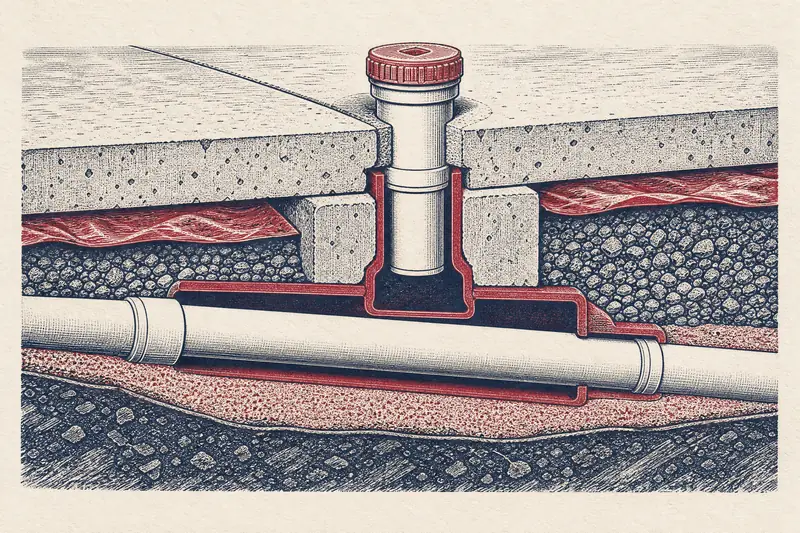
Underground plumbing is every pipe that ends up below the finished floor or in the ground: the building drain, branch drains to toilets, tubs and showers, the capped stub-ups that rise through the slab, and sometimes the water lines. The 2021 IPC gives it its own inspection, made once trenches are "excavated and bedded" and the pipe is in, ahead of any backfill (IPC 108.2). On a slab-on-grade house it is the first plumbing an inspector sees, before rough-in.
Basement and crawlspace houses have the same stage for the building sewer and anything buried below a basement floor. Some cities rename it; West University Place, Texas calls it "in ground" on its plumbing checklist.
What gets laid before the slab?
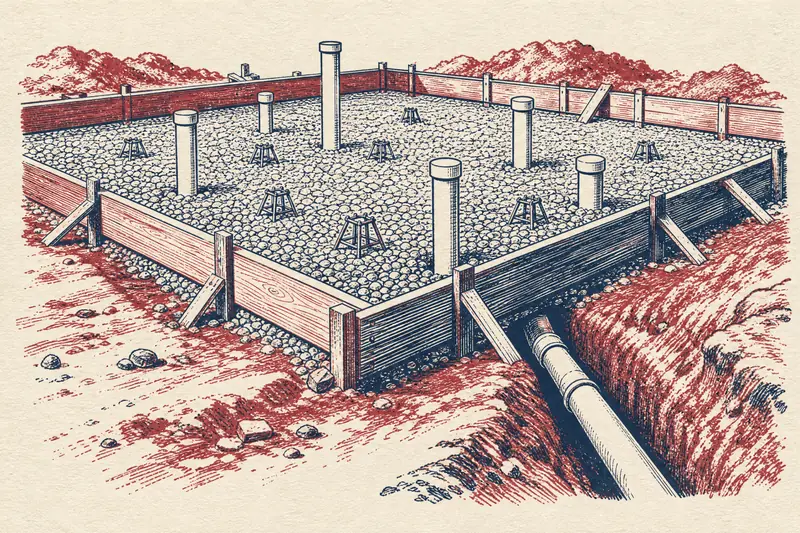
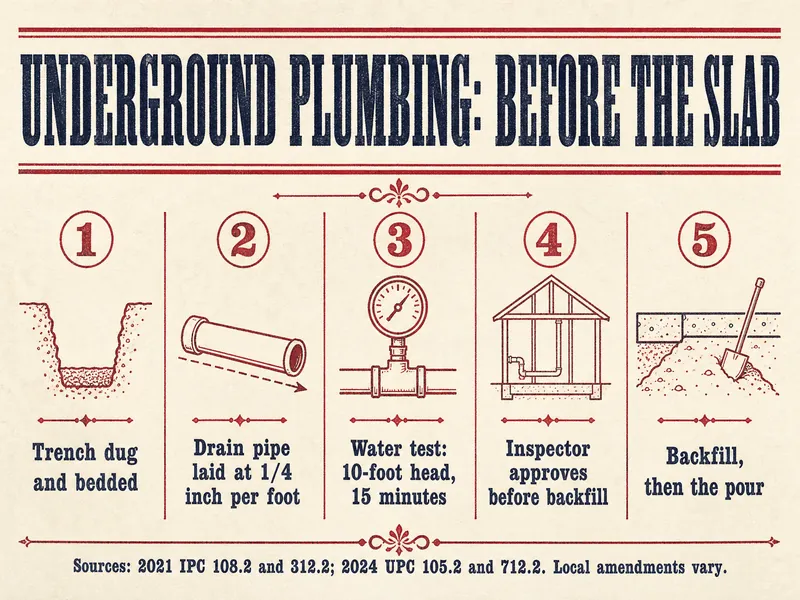
Every drain that must come up through the concrete is set at its final position and slope before the pour. The usual order: trench dug and bedded, drain pipe laid at 1/4 inch per foot or steeper, stub-ups capped at each fixture, cleanouts brought up, and sleeves placed where pipe crosses a footing, grade beam or foundation wall. Then comes the water test, the inspector approves before backfill, and it is backfill, then the pour. Under-slab plumbing covers slope, sleeves and cleanout spacing.
Water lines may run under the slab too, though pipe makers such as Viega want buried PEX in continuous lengths with no fittings below the concrete. Overhead or underneath is a design choice to settle at bid time; comparing plumbing bids shows what a bid should spell out.
How is underground plumbing tested?
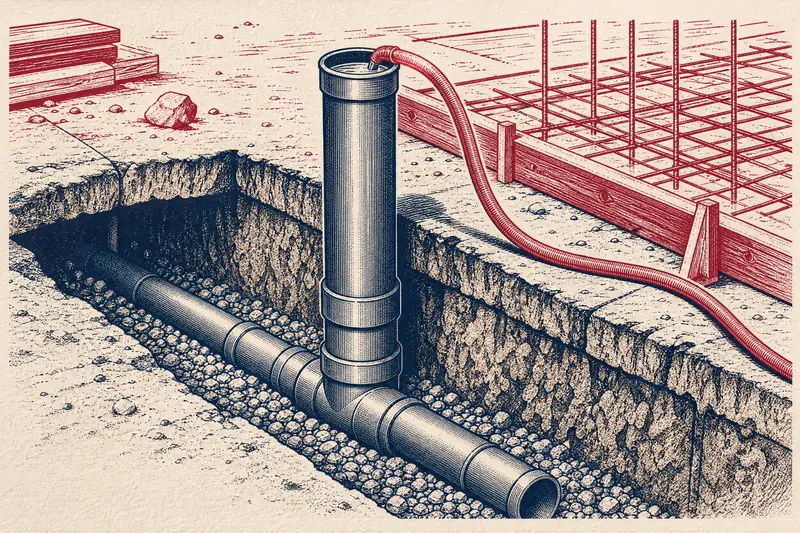
Underground drains are usually tested with water: openings are plugged and the pipe is filled to at least a 10-foot head, which has to stand for 15 minutes with no leaks (2021 IPC 312.2). The 2021 IRC (P2503.5.1) and 2024 UPC (712.2) use the same height and time. A 5 psi air test works only on metal pipe; plastic may take a vacuum test where the 2021 IRC applies.
Cities can ask for more. West University Place wants 20 minutes with no drop and the water kept in until the concrete goes in. The underground plumbing inspection page walks through the test, the inspector's other checks and what happens when a joint leaks.
Pages in this stage
When is underground plumbing inspected?
The inspector comes once the pipe is bedded and holding its test, and before any fill goes back in. The 2021 IPC makes the permit holder book it, and no work may pass that point until it is approved. Under the 2024 UPC (105.2.1), plumbing hidden before inspection has to be exposed again on the inspector's notice, which on a slab can mean digging out gravel or breaking concrete.
So the permit must be issued before trenching starts; the plumbing permit page covers who pulls it.
What should you photograph before the pour?
Photograph every pipe in the trench from two or three angles, with a tape stretched from a fixed point such as a form board or corner stake to each stub-up. Add a wide shot of the foundation, close-ups of each cleanout and sleeve, and the signed inspection card. Ask the plumber which test will be used and whether your city wants water left in through the pour. Those pictures become the map a future plumber uses to find a drain without guessing.
What goes wrong under a slab?
Most underground trouble comes from slope, bedding or a drain in the wrong spot. A drain laid too flat can hold waste, pipe resting on rocks can sag or crack under the slab's weight, and a toilet stub-up a few inches off the plan is fixed only by cutting concrete. Trenches beside a footing also have to stay out of its bearing plane, which the 2021 IPC (307.5) draws at 45 degrees down from the footing's lower outside edge.
Relocating a buried drain later is a project of its own; moving a toilet or shower drain explains what it involves.
Calls for the plumber and the inspector
- Pipe material, size, slope and cleanout locations are the licensed plumber's design, checked against the code your city adopted.
- Which test is used (water, air or vacuum) and how long it holds is set by that code and your inspector.
- Nothing is backfilled or poured until the inspector approves; covered work can be ordered uncovered.
- Stay out of open trenches; look and take photos from the edge.
- Your building department and a licensed plumber have the final word.
Underground numbers
- 10 fthead of water in a drain test, at minimumIPC 2021, section 312.2
- 15 minwater held before the inspection startsUPC 2024, section 712.2
- 5 psiair test pressure, never on plastic pipeIPC 2021, section 312.3
- 1/4 in per ftdrain slope for pipe 2-1/2 inches and smallerIRC 2021, section P3005.3
- 20 minin-ground static test, West University Place, TexasWest U plumbing checklist
| Code | Water test | Air test | Plastic pipe |
|---|---|---|---|
| 2021 IPC | 10-foot head, 15 minutes | 5 psi, 15 minutes | No air test |
| 2021 IRC | 10 feet above the highest fitting, 15 minutes | Non-plastic pipe only | Vacuum at -5 psi, 15 minutes |
| 2024 UPC | 10-foot head, in place 15 minutes before inspection | 5 psi, 15 minutes | No air test |
| West University Place, TX | 10-foot head, 20 minutes, kept in until the pour | Not listed for drains | PVC must be Schedule 40 |
Pressman's note
Sources for this hub: the 2021 IPC (108.2, 307.5, 312.2, 312.3), the 2021 IRC (P2503.5.1, P3005.3), the 2024 UPC (105.2, 712), West University Place's inspection checklist and Viega's PureFlow manual, read October 28, 2026. Not included: frost and sewer depths, which each jurisdiction sets, and prices.
Questions from the job site
Is underground plumbing the same as rough-in?
No. Underground covers pipe below the floor or in the ground and is inspected before backfill; rough-in covers pipe in walls and ceilings and is inspected before drywall. The IPC and UPC list them separately, with a final inspection last.
Does a house on a crawlspace get an underground inspection?
Usually for anything buried, such as the building drain and sewer. Pipe hung from the floor framing is normally checked at rough-in. Your building department's inspection list says which applies.
Can the slab be poured the same day the plumbing passes?
Often, if the other foundation inspections have passed too. Some cities want the test water still in the drains while the concrete goes in, so the plumber and concrete crew need to coordinate.
Do you need to be there for the underground inspection?
Not normally; the permit holder meets the inspector. If you want to watch, ask for the inspection window and stay outside the trench, and get a photo of the signed card either way.
What pipe is used for underground drains?
The plumber's bid names it, and your city's adopted code decides what is allowed. Plastic is common, and some cities narrow the choice to specific schedules.
Can the trench be backfilled early to save a day?
No. Work may not pass an inspection point before approval, and an inspector can order covered pipe dug back out, which costs far more time than it saves.