What Happens at Plumbing Top-Out
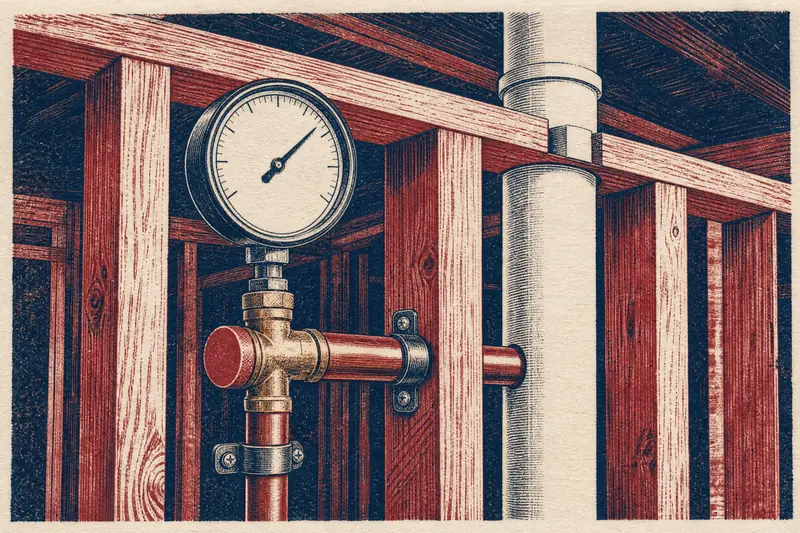
Plumbing top out is the stage where vent stacks reach the roof, tub and shower valves go in, stub-outs are capped, and the drain and water systems are pressure or water tested before drywall.
Set by the Trench to Trim desk from code, agency and maker documents · how pages are made · Updated
About the business links: Trench to Trim is run by the same people who own Plumbing Supply and More, SoftPro Water Systems and Quality Water Treatment, and it has a working tie to Central Plumbing & HVAC. No business pays for a mention. Who owns this site
Proof marks
- "Top-out" is a city term: Rio Rancho, New Mexico inspects it once above-floor piping is complete through the roof and walls; the model codes (2021 IPC and IRC, 2024 UPC) call the same check rough-in.
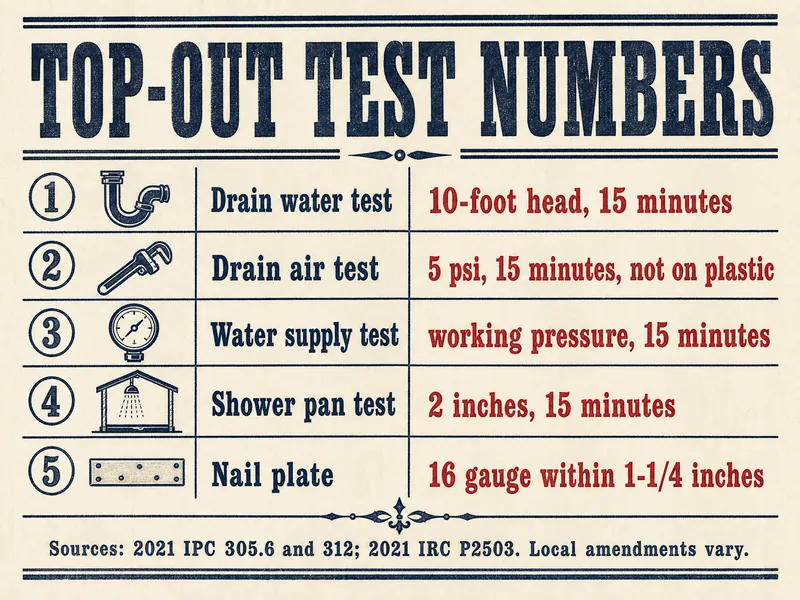
- The 2021 IPC drain test is a 10-foot head of water for at least 15 minutes, or 5 psi of air on pipe that is not plastic.
- Water supply pipe must hold at least its working pressure for 15 minutes under 2021 IPC 312.5, and PEX may be air tested only where its maker allows (2021 IRC P2503.7).
- Shower and tub-shower valves set now must be pressure-balance, thermostatic or combination types under 2021 IPC 412.3.
- 2021 IPC and IRC houses get a 0.0575-inch steel plate over any pipe closer than 1-1/4 inches to a stud's edge; 2024 UPC houses plate pipe within 1 inch, at 18 gauge.
- West University Place, Texas lists a static test, nail plates, notched joists, drain gradient and vent location on its top-out checklist.
What is plumbing top-out?
Plumbing top-out is the finishing pass on the pipe inside the framing, done after the drains and water lines are roughed in and before any wall is covered. Rio Rancho's plumbing inspections page sets its top-out inspection after "all piping above the floor to the extensions through the roof and/or walls" is done, and before anything is concealed. The 2021 IPC has no top-out; its rough-in inspection (108.2) covers the same moment, "prior to the installation of wall or ceiling membranes."
Many cities never use the word, so read your permit card. Where it appears, top-out sits between the underground or in-ground stage and the final, and it is usually the last plumbing sign-off before drywall. The top-out hub shows where it fits among the other stages.
Which parts are finished at top-out?
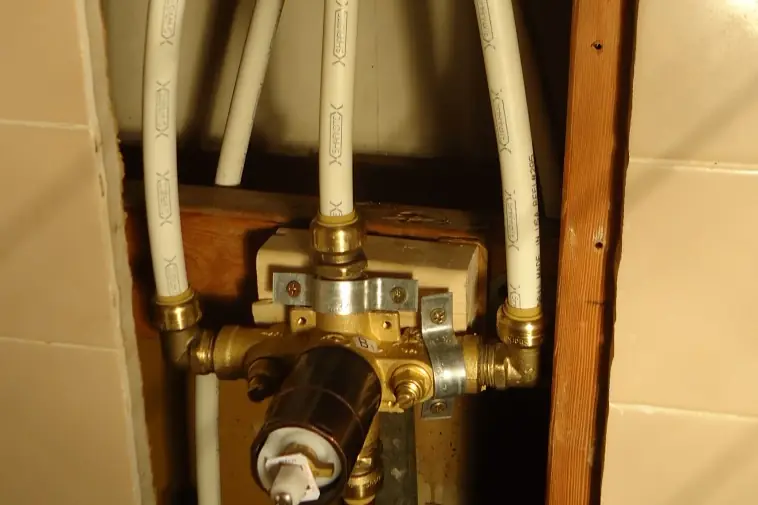
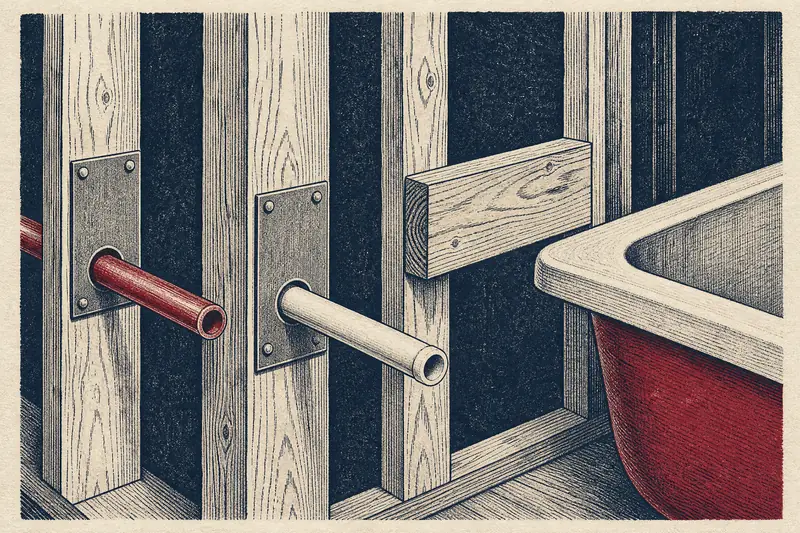
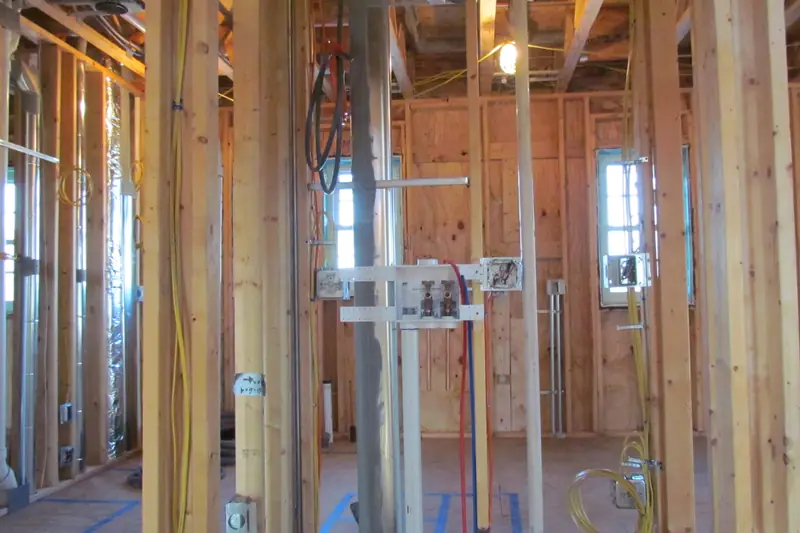
By top-out, every pipe that will hide in a wall or ceiling is in place and capped. That typically means vent stacks carried out through the roof with their flashings, tub and shower valve bodies mounted and piped, the tub spout and showerhead supply arms run, stub-outs for sinks, toilets and appliances capped, and steel plates on studs where pipe runs close to the face.
The valve body matters now because it can't be swapped easily once tile goes up. The 2021 IPC (412.3) requires individual shower and tub-shower valves to be "balanced-pressure, thermostatic or combination" types meeting ASSE 1016 or ASME A112.18.1, and pipe makers can add limits of their own: Uponor's installation manual says not to run its PEX between the tub/shower valve and the tub spout (Uponor). Anti-scald valves explains how those valves are set at trim.
Vents are part of the same pass. Where the IPC or IRC applies, an air admittance valve may stand in for some vents under conditions, including at least one vent to open air; UPC jurisdictions generally don't, unless a local amendment adds them. See plumbing vents for that choice.
How are the drain and water systems tested at top-out?
The drains and vents get a water, air or vacuum test, and the water lines get a pressure test, all while the pipe is still visible. Under 2021 IPC 312.2, the drain system is plugged and filled so no section sees less than a 10-foot head. The air alternative (312.3) is 5 psi and is off limits for plastic pipe. The 2021 IRC adds a vacuum test at -5 psi that plastic drain pipe may use.
West University Place's top-out checklist shows a common field method: a riser run from a lavatory up past the highest top plate and filled to the top. For the water lines, the 2021 IPC (312.5) wants the system "tested and proved tight" at no less than its working pressure, or with 50 psi of air on non-plastic pipe, using potable water. The 2024 UPC (609.4) lets PEX, PP or PE-RT be air tested where the maker permits it.
The plumber seals each opening for these tests with test caps or plugs. To see what those parts are called and how they're specified, so a line on the bid or an inspector's note makes sense, look at Plumbing Supply and More's test plugs (Plumbing Supply and More, run by the owners of Trench to Trim); setting them is the licensed plumber's work.
How long does a plumbing top-out test hold?
The model-code minimum is 15 minutes for drain, vent and water supply tests alike. The 2021 IPC holds the drain water test "for not less than 15 minutes," the air test for a "test period of not less than 15 minutes," and the supply test for the same time. Under the 2024 UPC (712.2), that quarter hour is counted before the inspector begins. Some cities ask for longer; West University Place sets 20 minutes for its in-ground test.
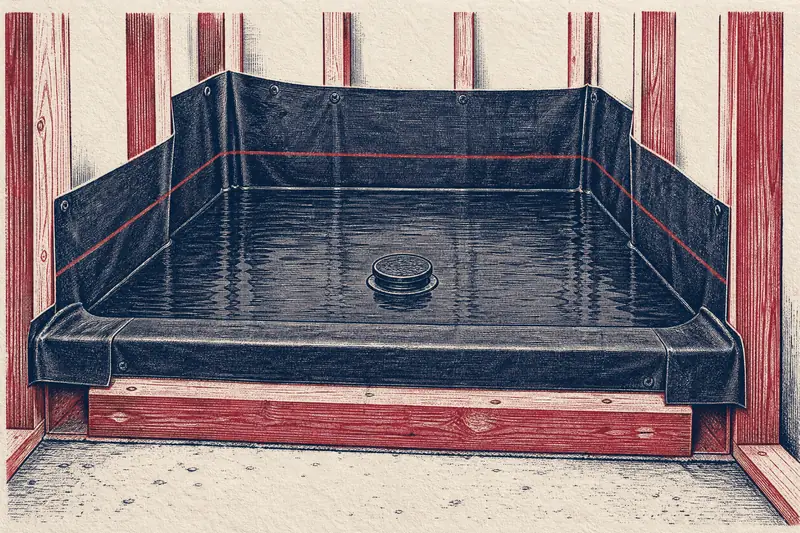
A tiled shower pan is the longer exception. The 2021 IPC (312.9), IRC (P2503.6) and UPC (408.8.5) all flood the liner to 2 inches deep for at least 15 minutes, but Minnesota's code, as Owatonna applies it, calls for "a minimum duration of 24 hours," and many inspectors elsewhere ask for a day too. The shower pan liner test page covers that test.
What do inspectors flag at top-out?
The usual flags are a test that doesn't hold, pipe without protection near the stud face, framing cut too deeply for pipe, and drains or vents out of place. West University Place's top-out list makes a useful model. Its inspector runs the static test, looks for plates and for joists bored or notched where they shouldn't be, checks for "Proper gradient of DWV" and insulated water lines, and confirms no roof vent sits within 10 feet of an operable window or air intake, a local rule.
Pipe protection is the item homeowners can check most easily. Under 2021 IPC 305.6 and IRC P2603.2.1, a bored or notched stud whose pipe sits closer than 1-1/4 inches to its edge gets a 16-gauge steel shield, carried 2 inches past the sole and top plates. UPC jurisdictions (2024 UPC 312.9) trigger the plate at 1 inch, accept 18 gauge, and run it 1-1/2 inches beyond the pipe. Nail plates and blocking shows where plates and backing go. When something fails, the inspection failures page covers how corrections work.
What should you photograph before drywall?
Photograph every open wall straight on, with a tape measure hooked on the subfloor or a corner, before insulation or drywall covers it. Get each valve body, each capped stub-out, every steel plate and every block of backing, and a close-up of any pipe label you can read. These photos tell you where not to drive a screw and where to open a wall if a leak ever shows up.
Top-out walk-through
Ask the plumber
Which test was run on the drains and on the water lines, how long it held, and whether the shower pan test is part of this visit.
Measure
Shower valve and head heights, tub spout height, and each stub-out from the subfloor and nearest corner.
Keep
Photos, the signed card, and the valve maker's spec sheet so the right trim can be ordered.
Plumber's and inspector's calls
- Test type, pressure and duration follow the code your city adopted; air or gas tests on PEX happen only where the maker allows them.
- Vent sizing, air admittance valves and where vents leave the roof are the plumber's design and the inspector's approval.
- Gas piping is a licensed plumber's or gas fitter's job with its own test. If you smell gas on site, get everyone out now; don't flip switches, use phones, light anything or start a car inside; once outside and away, call 911 or the gas utility.
- Shower valve limit stops are field-adjusted to the maker's instructions so the water does not exceed 120°F.
- Your building department and a licensed plumber have the final word.
Top-out test numbers
- 10 ftwater head, at minimum, in a drain testSection 312.2, 2021 IPC
- 5 psiair test on drains that are not plasticSection 312.3, 2021 IPC
- -5 psivacuum test permitted for plastic drainsSection P2503.5.1, 2021 IRC
- 50 psilowest air pressure for metal supply linesSection 312.5, 2021 IPC
- 24 hrshower pan flood test under Minnesota's codeOwatonna, MN self-certification form
| Item | 2021 IPC | 2021 IRC | 2024 UPC |
|---|---|---|---|
| Drain water test | 10-foot head, 15 minutes | 10 ft over the top fitting, 15 minutes | 10-foot head, held 15 minutes ahead of the inspector |
| Drain air test | 5 psi, 15 minutes, not on plastic | Non-plastic pipe only; vacuum for plastic | 5 psi, 15 minutes, not on plastic |
| Water supply test | Working pressure, 15 minutes | Same; PEX air only if the maker allows | Working pressure, 15 minutes; PEX air if the maker allows |
| Shower pan test | 2 inches, 15 minutes | 2 inches, 15 minutes | 2 inches, 15 minutes |
| Nail plate | 16 gauge within 1-1/4 inches | 16 gauge within 1-1/4 inches | 18 gauge within 1 inch |
Pressman's note
Code text read October 28, 2026 for this page: from the 2021 IPC, sections 108.2, 305.6, 312.2 to 312.5, 312.9, 412.3 and 412.5; from the 2021 IRC, P2503.5.1, P2503.6, P2503.7 and P2603.2.1; from the 2024 UPC, 312.9, 408.8.5, 609.4 and 712. City practice comes from Rio Rancho's inspections page, West University Place's checklist and Owatonna's shower liner form; the PEX limit is from Uponor's installation manual. A single vent height above the roof is not given, because the IPC leaves it to each jurisdiction, and there are no prices.
Questions from the job site
Is top-out inspected separately from rough-in?
In some cities, yes; Rio Rancho and West University Place list it as its own visit. Elsewhere it is part of the rough-in inspection. Your permit card names the stages you need.
Does the tub need to be in place at top-out?
Often, because the tub's drain and overflow and the valve and spout are set around it before the walls close. Tub fillers that aren't part of a tub-shower valve need an ASSE 1070 temperature-limiting device, or a water heater meeting ASSE 1082 or 1084, under the 2021 IPC (412.5). Ask the plumber when the tub will be delivered.
Can the plumber test with air instead of water?
Only on drain pipe that isn't plastic, under the IPC and UPC, and on PEX water lines only when the maker's instructions allow it. The IRC gives plastic drains a vacuum test. Your inspector decides which method is accepted.
Why are there caps on every pipe sticking out of the wall?
The caps seal the system so it can be tested and keep debris out until fixtures go on at trim-out. They come off when the stop valves and fixtures are installed.
Are water lines insulated at top-out?
Sometimes. West University Place, for example, checks that water lines near outside walls and in exposed spots are insulated at its top-out visit. Ask whether your plan calls for pipe insulation and where.
What comes after top-out?
Insulation and drywall, then tile and finishes, then trim-out and the final inspection. The trim-out stage covers setting fixtures and the final sign-off.
Related pages
Back to the job board, stage by stage